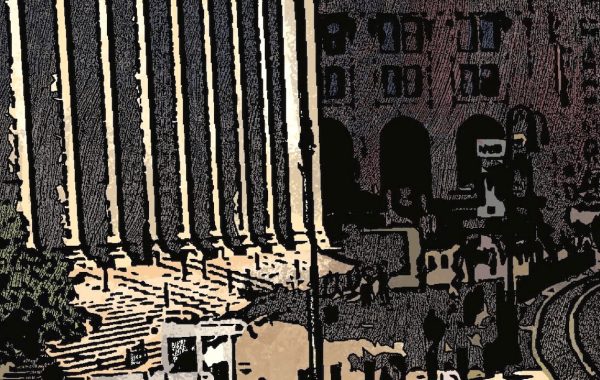
That’s the side of the Woolworth Building, taken from the 44th floor of a nearby building. The two buildings track closely in floor-to-floor height: the setback on Woolworth is at its 45th floor. When people first started building skyscrapers, they talked about the views from the windows and the views of the buildings from the streets, but they rarely mentioned the views of tall buildings from other tall buildings. In part, that’s because until you have a bunch of tall buildings, those views are rare.
Woolworth is famously gothic in style, although underneath it’s got a fairly normal New York steel skeleton frame. Those big terra cotta piers aren’t capable of carrying the building and they don’t. But, if its 1913 completion date was so early in the air-travel age that aerial photographs were still called “bird’s eye views” and if the view from other skyscrapers wasn’t a driving force, why is all that detail there? The closest a person in the street would be to the 45th floor of Woolworth is about 500 feet (150m) away, and few people have eyesight keen enough to make out all the striations and crockets from that far.
One reason is a cross between perfectionism and a desire for some kind of architectural authenticity. Even if the Gothic styling bears no resemblance to the actual structure of the building, it would strike most people as odd in the 1910s for a building to have detail in some areas (the lower floors) and not others. There’s an argument to be made today that such an arrangement would be post-modern, and architecture at that time was just beginning to catch up to the modern itself.
The reason that in some ways is the most convincing is economic. The building had to have exterior walls. And at that time, exterior walls meant masonry. Terra cotta was an efficient way to cover large areas of facade, and once a mold was created in the shop, it was cheap to churn out hundreds and thousands of identical blocks. In other words, except for some small amounts of specialized ornament, like the pinnacles at the corners above the setback, there was not really any additional cost in continuing the ornate terra cotta to the upper floors. If the facade ornament were carved stone or patterns laid into brick , this would not be true.