
The Battery Park City master plan created a pleasant park around the South Cove, an indentation in the landfill shoreline that, unlike the North Cove, is too small to be a harbor. It’s technically the north end of Wagner Park (named after Robert Wagner) and is a little over twenty years old. Much of the park furniture, including some of the handrails and benches, is wood. Facing the cove is a folly (a metal structure similar in size and shape to the crown of the Statue of Liberty) and in the cove itself is a kind of water-borne folly pathway: a wood structure similar to a pier but curved and leading nowhere. The curve of that pier folly surrounds a tiny island. You can walk around the island and edge of the cove or over a humpback bridge that crosses from the main park to the island and back again. The pier folly and the bridge are currently being reconstructed, as a fair percentage of the wood had rotted.
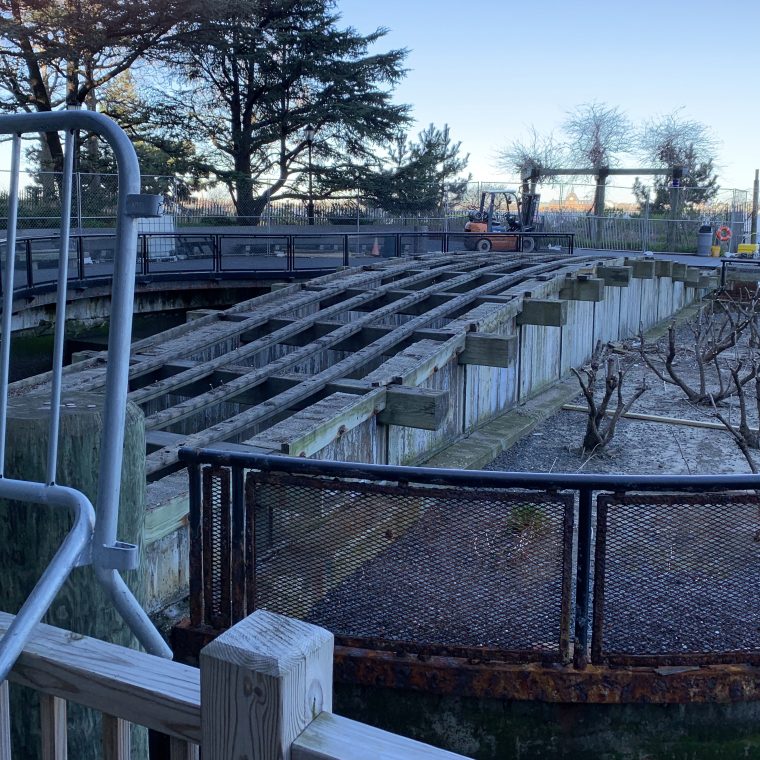
The picture above shows the bridge with the plank decking removed. You’ve got two concrete walls with the humpback shape supporting large timbers, and the timber support the decking.
The bridge is, really, as fake as the pier. The two parts that are over water are six feet long, and the big hump in the middle – the part that seems like “a bridge” is over the island. That’s fine, as the whole assembly is there for amusement, to provide some variety to the promenade along the water. What I find fascinating is that building this fake bridge required more or less as much structure as building a real one would. That’s a lot of concrete and a bunch of big timbers to span six feet twice. The large amount of material partly because the same safety requirements apply regardless of the meaningfulness of the bridge and partly because there was a certain aesthetic goal in the design.
In other words, building a fake isn’t necessarily any easier than building for real.