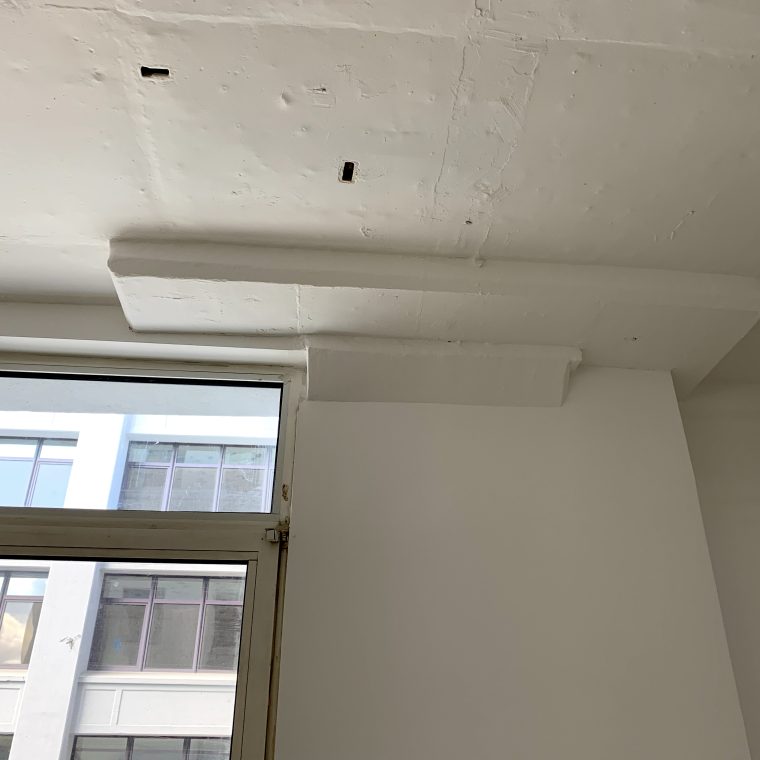

That’s a picture of what may be the smallest ratio of column capital to column size ever built. The column is the rectangular bump in the wall just to the right of the window, and it measures roughly 18 inches deep and 30 inches wide. There are similar columns all along the perimeter of the building. The left edge of the column aligns with the edge of the window; you can’t see the right edge of the column because a gypsum-board enclosure has been built flush-front with the column and to its right. What looks like the right edge of the column is just part of that enclosure, about a foot to the right of the hidden actual edge of the column.
This is a flat-slab building, so that there are no beams, just slabs, columns, and column accessories. One of the column accessories is called a “drop panel”, and consists of a thicker area of slab around each column to increase resistance to punch-through shear and increase the negative moment capacity around the column. In this case, because the column is right up against the wall, the drop panel is that wide and short rectangular bump in the ceiling that runs from the middle of the first window panel on the left to just past the edge of the column on the right.
The other column accessory of note is the capital, which again served to provide additional strength for punch-through shear. This building generally has round columns with flared capitals, which was a common form in the 1920s, when it was built. Round columns don’t easily mesh with the geometry of a masonry curtain wall, so the edge columns, like this one, are rectangular. As a result, the flared capital here is reduced to a small triangular prism, stuck in-between the drop panel and the column proper. Frankly, it looks ridiculous.
The obvious question is: why? Why build this? One easy answer – that all the interior columns have drop panels and capitals so the engineer and builder just kept going with the idea on the exterior columns – is almost certainly wrong. A lot of effort went into building those vestigial drop panels and capitals and no one expends all that effort because they forgot not to. Another easy answer – that the concrete is weak by modern standards – sounds a bit better, but the concrete isn’t all that weak. It was designed to have 2000 psi compressive strength at 28 days versus the 4000 psi that’s the standard minimum today, and was tested at over 2500 psi. So yes, it is weaker than the material used now, but not enough to explain this detail.
The most likely answer is that they had to because of the design requirements of the time. There was not a concrete code in the modern sense in the 1920s. Rather, a number of organizations that had an interest in concrete construction – including the American Society of Civil Engineers, the American Society for Testing Materials, the American Railway Engineering Association, the American Concrete Institute (who would eventually put out a concrete code in the 1940s), and the Portland Cement Association – created the “Joint Committee Report” that served as a de facto concrete code. The report was quite conservative with, for example, very low allowable stresses for punch-through shear. And there’s my guess: the low “code” value for this specific design item forced the designers to ask for the capitals and drop panels at these locations and thus forced the builders to construct them.
You can read the relationship between built artifacts and written standards in either direction: reading codes and other documents tells you what to expect in a building of the era that those documents were in force, while looking at the buildings of an era tells you what people thought was required of them.