
The idea that technological development happens in groups of related fields is not a new one. The traditional definition of the industrial revolution centers on a cluster involving coal mining, pumps to keep the mines dry, steam engines to run the pumps, and iron-working powered by coal. There’s a similar cluster closer to home for me involving steel framing, riveting, and the entry of structural engineers into the world of building design.
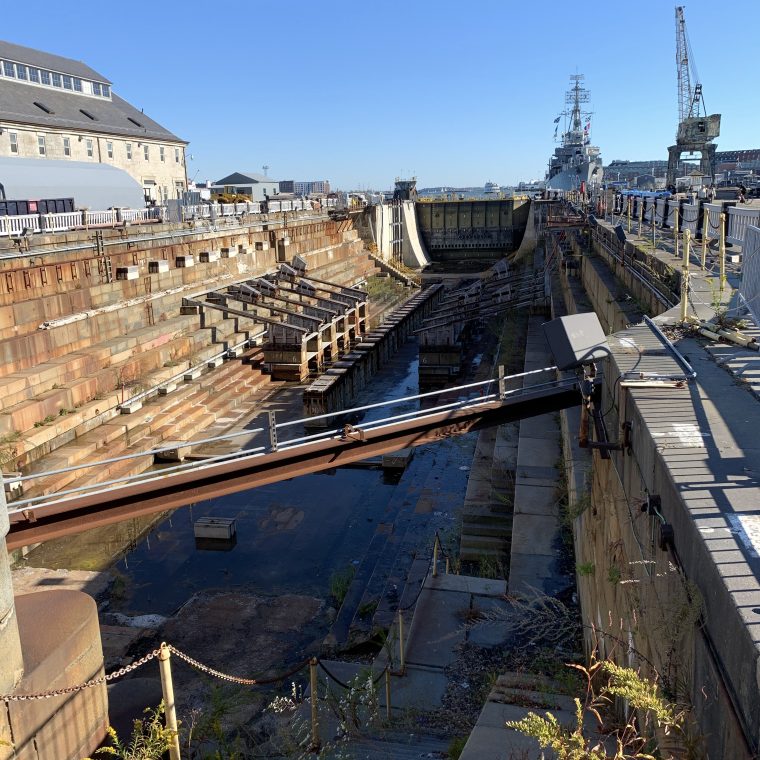
The picture above is Dry Dock 1 at the Charlestown Navy Yard, across from Boston. It was one of the first two dry docks built in the US, opened in 1833 along with one at the navy yard in Norfolk, Virginia. Dry docks made the maintenance of wood-hulled sailing ships much easier and became critical facilities once iron-hulled ships were introduced.
Dry docks are quite similar to an older element, the canal lock. A dry dock like the one above is effectively a canal lock with only one set of doors (the other end being solid wall) and that is emptied by pump rather than by gravity. That second difference is the critical one. A canal lock fills and empties entirely by gravity: the water level within the lock is lowered from its upper level by feeding through a pipe or sluice to the lower level; the water level within the lock is raised from its lower level by being fed through a pipe or sluice from the upper level. The only mechanical action required is opening and closing the doors and the valves. The dry dock replicates half of this: when the dock is empty of water, it is filled by allowing water in via a pipe. But there is no way to gravity-feed the water out to empty the lock, so it has to be pumped out.
The original construction of this dry dock looks very much like the construction of canal locks of the era. The 1830s were the US’s golden age of canal construction, after the Erie Canal showed what was possible and before railroads took over long-distance transportation. Unsurprisingly, the engineer who designed the dock, Loammi Baldwin Jr., had canal experience. That kind of personal link, a kind of internal technology transfer, is common in this kind of technology cluster.

