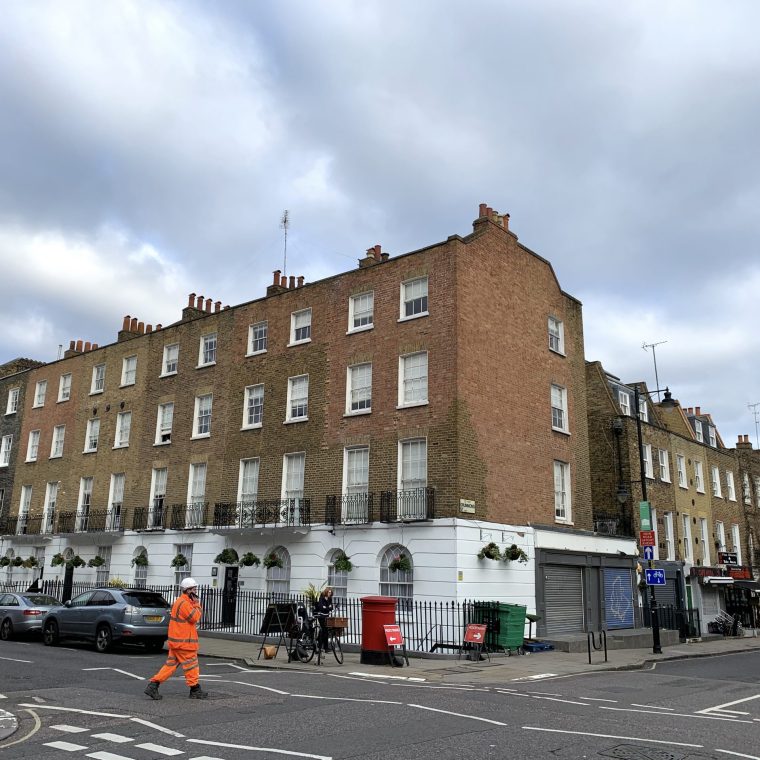

When I was discussing rowhouses a week ago, I mentioned in passing that I think of rows of houses that are absolutely identical as being “London style” rowhouses. The picture above shows a mild example: the row of eight houses on the left have been modified a bit (and apparently, based on changes in brick color, repaired a lot) since they were built. Even so, that’s a row of houses more similar to one another than most NYC rows. But it’s quite easy to find much more extreme examples. For instance, here’s a longer brick row:

It’s hard to tell – and, again, I’m an outsider looking at building history in a country I’m much less familiar with than I am with the US – but it sure looks as if that entire block front was built as a single row of absolutely identical houses, and over the years some have had their mansard roofs converted to full floors. Even with that change, this is a remarkably consistent row, with only variations in plants and the state of cleanliness of the brick providing visual clues as to the junctures between the separate buildings. Here’s another example:

That stone-faced row doesn’t quite fade off into the distance: after it ends, some 22 identical houses from the intersection at the right, another row starts up. Again, if it weren’t for the TV antennas, chimney pots, and dirt, it would be difficult to tell one from the next.
I don’t know why the English built rows of absolutely identical houses while we built rows of similar but distinguishable houses. I’m not going to play armchair psychologist/sociologist to make guesses. But that difference provides one very small visual difference that distinguishes one city from another. Even if you don’t consciously notice it, seeing the version you’re not familiar with feels subtly different.


You must be logged in to post a comment.