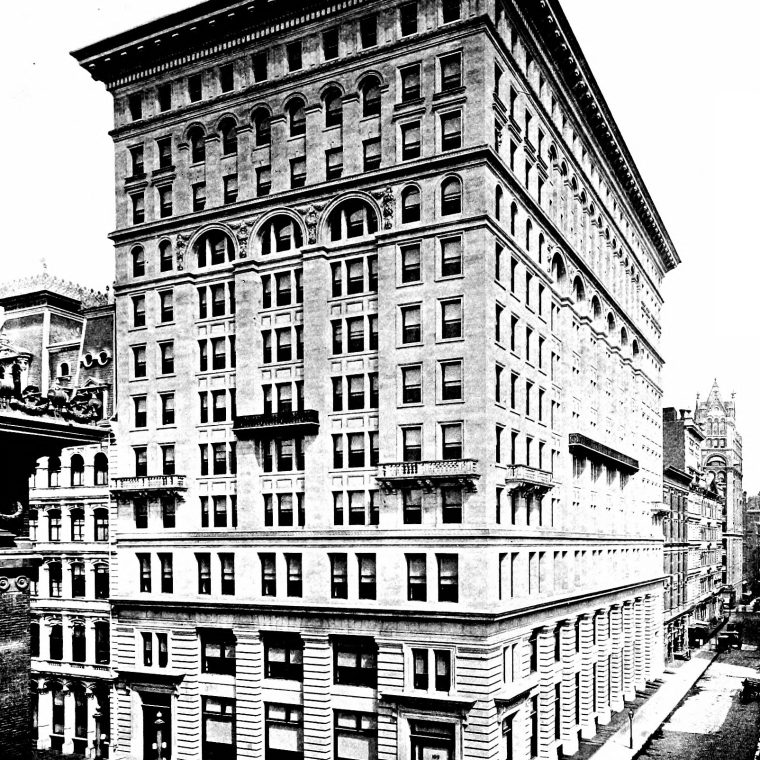

Yesterday’s post about construction progress at the Woolworth Building had an obvious flaw: when you’re building the tallest building in the world, you may be acting differently than when you build a more ordinary structure. The building above, the 1895 Constable Building at Fifth Avenue and 18th Street, was actually quite tall for its time, but nowhere near the record height and, as you can see, not very slender. (Stockier buildings are easier to design and build.)
The Constable Building was, and is, an office building with retail at the ground floor. It’s next door to the Arnold Constable store, which was a high-end department stores in New York for much of the 1800s and 1900s. Both the store and the office building are landmarked as part of the Ladies’ Mile Historic District. (Scroll down to page 222 in the landmark report at the link.) The Constable building’s rent roll provided income for the store, and the building itself was potential future expansion space. It was a modern structure for the mid-1890s, with a skeleton frame and relatively thin curtain walls. Courtesy of the general contractor, Marc Eidlitz & Son, here are some very low-resolution* photos:


The most obvious piece of information is how fast this building went up. From two floors of steel above grade in March to a nearly completed exterior four months later. That is fast for any era. I wonder if the builders of early skeleton-frame buildings were so obsessed with speed because the new construction technology allowed them so much more freedom in logistics than bearing-wall technology. Once you can decouple the construction of floors from the exterior masonry, why wouldn’t you want to?
Secondly, the use of sidewalk bridges during construction in NYC dates back to at least 1894. It’s clearest in the July picture, but can be seen in the May and June pictures as well. Note that in the March picture, when the active construction was near grade, there was a fence rather than a bridge.
Finally, I’m fascinated by the unevenness of the facade construction. In May, with the facade work just getting started, it’s lagging at the rear (east) end of the building. In June, with the frame topped out, the lag is rather extreme; in July, the masonry is nearly done but the cladding on the (steel frame) cornice is lagging at the east. There are a number of reasons this could be true, but the most obvious are (a) too slow delivery of the limestone for the veneer or (b) not enough skilled masons available. Given the Eidlitz company’s position as one of the top builders in the city at the time, I suspect there was some kind oof problem with the fabrication or delivery of stone, but it’s unlikely that the answer is now discoverable.
* These are actually photographs, even though the first two look like line drawings. They were four on a page, so even at a high scanning resolution there wasn’t going to be all that much detail. The scans seem to have been accidentally posterized, which is to say graduations of color (or in this case gray) lost, leaving only black and white.

You must be logged in to post a comment.