

I really want the pictures to speak as much as possible for themselves today, because I suspect most people will have the same jaw-dropping reaction I had. Again, these are from Building the New Rapid Transit System of New York City, a description of the 1910s expansion of the subways system.
Part of constructing a cut-and-cover tunnel is deciding what to do temporarily, during the “and” period between when the street is excavated and when the new structure is complete. In the case of the IRT and BMT companies, there wasn’t much to decide: they were required to keep the street and utilities operational except when there was no choice but to cause disruption. The solution was to build temporary timber structures providing a temporary street. Here’s a view of a timber street with part of the top decking missing, exposing the framing below:

Here’s a general view underneath that top deck, in an area where the cut was in soil:

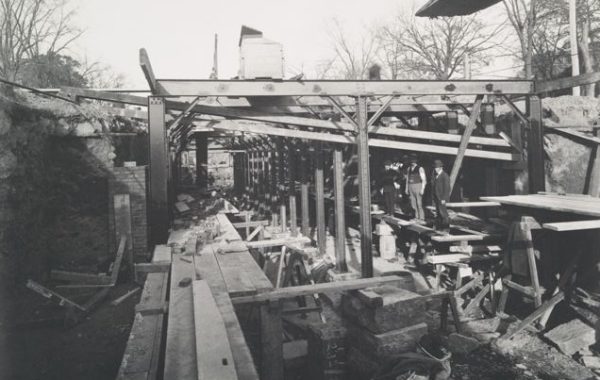
And here’s a general view underneath in a rock cut:

Another all-timber street, with steel girders carrying (via a dozen hangers on each girder) a portion of the deck from above:

In an area with a little more room, the girders were below the deck, and resting on piles:

The new Lexington Avenue tunnel, from Grand Central (42nd Street) north, was a particularly difficult portion of the work because the narrowness of the street meant that the tracks had to be on two levels, with the local trains above the express. Here’s a sketch of the temporary wood structure, with steel girders, over that deep cut (note the streetcar tracks at the top, seen as trapezoids with circular holes):

And here’s a photo, looking very much the same, but messier:

There’s a general problem with our view of the past: we think of it as static. In realty, things were changing just as they do now. In a rapidly-growing city like New York, they changed very rapidly. We don’t think of New York in the 1910s as having major streets made of wood plank for years at a time, but they were.

You must be logged in to post a comment.