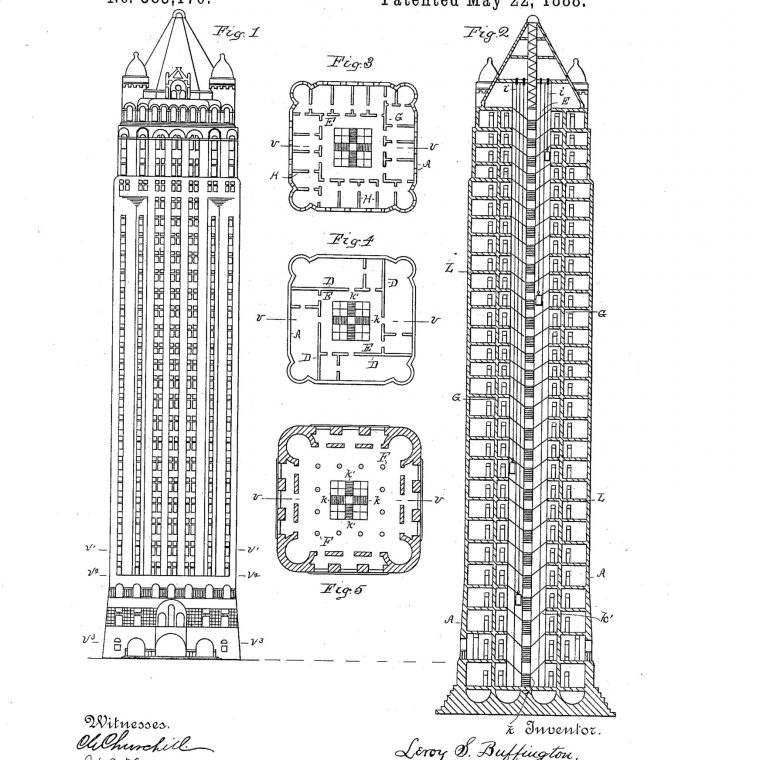

The first skeleton-frame buildings (with a frame supporting all loads) in the United States were constructed in 1890; the first cage-frame buildings (with a frame supporting all loads except for the exterior walls) were constructed about five years earlier. The picture above, from Leroy Buffington’s 1888 patent, represents a weird side-alley/dead-end in the history of frame development. I wouldn’t ordinarily take up space for an idea that was never built and may not have been buildable, except that there have been serious histories of design and construction that felt this patent was worth mentioning.
Buffington’s proposal is a hybrid. First, it was somewhere in-between a skeleton-frame and cage-frame proposal: the metal frame does not properly support the exterior walls. That’s not the only backward-looking piece of the design. At the risk of making the rubble bounce, the building section on the right above shows inverted-arch foundations. The interior columns, surrounding the stair and elevator core, are cast iron. And the lateral bracing is solely within the columns at the perimeter, without engaging the interior framing. A floor plan and time details:

Figure 6 is a plan that shows the interior cross-plan open stair surrounded by elevators. As history would show, open stairs and open elevator shafts were a terrible idea in terms of fire safety, but this wasn’t yet really understood in the US in 1888, so it’s unfair to Buffingotn to suggest he should have known. The little rectangles around the perimeter are steel columns, shown in side elevation (a wall cross-section) in Figure 12. The circles around the core are cast-iron columns, shown in Figure 16. Some more details:

Figure 15 shows an interior elevation of an exterior wall; Figure 10 is a perspective view of the same and arguably the best detail to understand the design. The exterior wall is masonry, and the perimeter columns are built up of a bunch of steel plates riveted together. Figure 13, in the second illustration, shows one of these plate columns from the interior looking out. There’s a plate lintel spanning column to column to support the wall – “s” in Figure 10″ – and supported on plate outriggers riveted to the exterior columns. In between the columns and the inside face of the masonry is a layer of “mineral wool or other non-conducting substance” as insulation.
So, kudos to Buffington for including the idea of a supported exterior wall. He didn’t invent it, as the idea had been around in other forms, but he was showing it in a tall metal-frame building. But, (a) the lintels wont work because they’re too flexible, (b) the lintel and outrigger combination undoes whatever thermal distancing the insulation gave, and (c) the location of the cross-bracing means it was also not insulated. I’m not going to criticize Buffington for not including expansion joints in the facade, seeing as how people were still building high-rises with inadequate expansion joints up until around 1970, but his ideas for supporting the wall and preventing destructive differential thermal movement simply won’t work.
Because the perimeter columns are bundles of plates, they’re not very easy to attach to, which is why the perimeter beams seem to be magically floating and the beams perpendicular to the wall don’t run to the columns, but run next to them. Modern tube-frames rely on the floors as diaphragms; this is structurally closer to a chimney, a tube without significant interior bracing. And of course the interior cast-iron columns contribute nothing to lateral load resistance.
There’s no shame in a first iteration of an idea having flaws. But because this concept was never built, it never developed. It’s a blue-sky version of the idea that was not subjected to the reality of construction.
As always, with this kind of topic, I’ve discussed it in the soon-to-come history.

You must be logged in to post a comment.