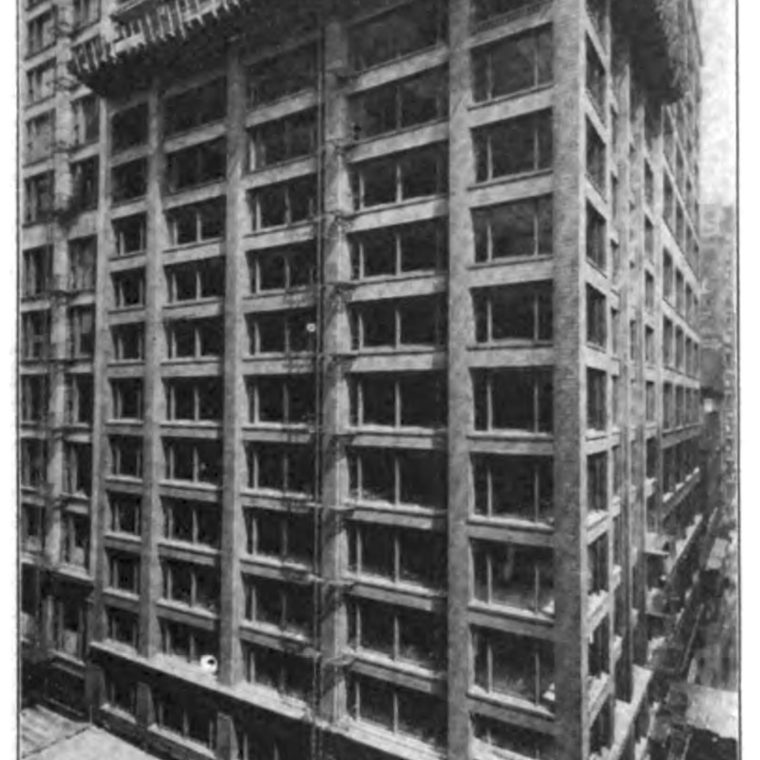

The Champlain Building in Chicago, built in 1894, was demolished in 1915. The picture above, which could pass for a construction photo, shows the beginning of the structural demo: the windows and interior build-out are gone, and the frame and exterior-wall removal has just started.
Holabird & Roche, the architects for Champlain, took the opportunity to review the condition of the steel during the demolition, and reported on it to the Engineering Record. This kind of end-of-life review of steel conditions happened fairly often back then – for example, when the Pabst Hotel was demolished – as people tried to understand the aging of the still-new steel-frame technology. The steel had been protected by two coast of “mineral paint” – probably red lead paint, which was a standard primer paint for steel – and then by being coated with Portland-cement mortar, either in the form of concrete fireproofing encasement or terra-cotta block fireproofing.
The architects found that the paint “has deteriorated beyond all usefulness” but that the steel was in generally good condition, with the worst steel loss from rusting being less than 1/100 of an inch thick, and possibly having occurred before construction was complete. They attributed the good conditions to the “exclusion of air and moisture” by the cement. This was not an idea that they came up with: there is a fair amount of literature from the proceeding thirty years on the topic of protecting building steel from rust, and one prevalent thought is that a layer of cement is good protection.
It turns out that there were some flaws with this idea. The first flaw was that the protection provided by the cement was protected from mechanical action that could damage it. This was wrong because, as we now know, cracks can form in facades without frame damage, admit water, and then rust-jacking forces the cracks open. The second flaw was mentioned in the article: secondary steel members used to anchor the terra-cotta facade were badly rusted when “they were not well bedded” in the mortar. In other words, imperfections in the cement layer would lead to rusting. The third flaw was the belief that damage is a linear process – that you could extrapolate from twenty years of weathering to one hundred. This is not true because of the way that damage accelerates over time (such as rust-jacking opening new cracks, and delamination exposing new steel to water), because of the fact that the rust weakens spandrel beams and so causes movement that causes more cracking, and because of the fact that cement is ultimately not waterproof, but only slows water penetration.
It took a while for the mistaken ideas people had about waterproofing steel to cause problems. There were isolated failures in the 1960s, a lot of failures in the 1970s, and, one by one, cities started passing facade inspection laws since 1980 to have professionals look for masonry and steel damage.
I’m not blaming anyone. It is very easy to look back on 130 years of steel-frame construction and see the problems; it was much more difficult to foresee them when they had not yet occurred.

