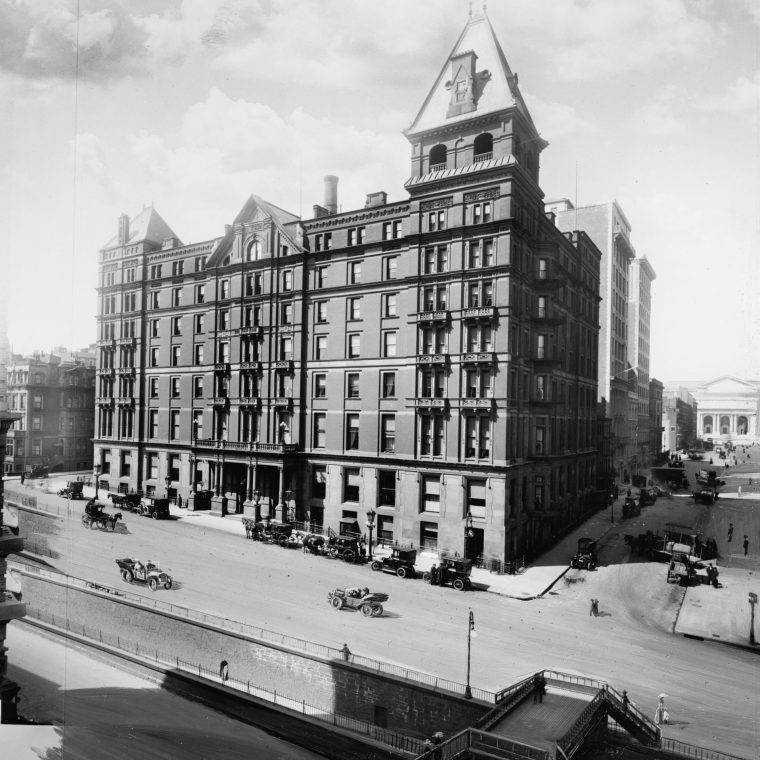

The focus of that photograph is the Murray Hill Hotel, on the west side of Park Avenue between 40th and 41st Street, in the early years of the twentieth century. It was constructed in 1884 to serve the then-twelve-year-old Grand Central Depot nearby and was among the earliest fireproofed hotel structures in the city. The photographer – or whoever developed the negative – appears to have been trying to fix some over-exposure along the bottom edge. And now we move from hard facts to inferences.
First, the Library of Congress says that the photo is dated between 1900 and 1910, but it’s almost certainly later: on the far right, off in the distance, we can see the classical New York Public Library, which wasn’t complete on the outside until 1906. The date is later than that: the tall building on the right, on the south side of 41st Street and separated from the hotel by two rowhouses, is the Chemists’ Club, which was completed in 1911. A building’s exterior can be complete while the interior is still in construction, but the club puts this photo as no earlier than 1910.
There’s a line of vehicles, likely cabs, parked in front of the hotel. Four are automobiles, three are horse-drawn. The car revolution kicked off by the Model T started in 1908, but there was, of course, a long overlap period before horses were gone from the city streets. On 41st Street, there appears to be a horse-drawn goods wagon either making a delivery or making a U-turn. (If I knew anything much about old cars, I might be able to better date the photo from the vehicles.)
The most interesting thing in the photo is the open cut in the foreground, with a small bridge allowing pedestrians to cross over. This little cut has a convoluted part in New York’s transportation history. The tracks from the Harlem River on Park Avenue south to Grand Central were built as part of the Harlem River Railroad, which became a part of the New York Central empire and gave a central route for the Central (and the Hudon River Railroad) into Manhattan. In the late 1830s, steam trains continued as far south as 26th Street, with horses pulling the cars down to Park Row. The line served as mass transit up the east side, with stops not much less frequent as the modern subways. The cut was first made for the simple reason of reducing the track grades past Murray Hill.
The cut was deepened and partially decked over (further south than this photo) in the 1850s, leading to a stretch of Fourth Avenue getting the “Park Avenue” name for the first time. The city banned steam locomotives south of 42nd Street in the early 1870s, leading to abandonment of the 26th Street and the construction of the first Grand Central at 42nd; the cut continued in use for street cars. In 1898 the street cars were switched from horse-drawn to electric trolleys.
The Park Avenue viaduct, carrying the street around the new (third) Grand Central was completed in 1919, and ended at 40th Street. Eventually, someone got the idea of converting the cut to an extension of the viaduct and decking it over completely, and in the late 1930s, that work was completed. You now enter the tunnel at 33rd Street, go from the tunnel to the elevated viaduct at 40th Street, and go around the railroad terminal to return to the regular Park Avenue at 46th Street.
This photo was taken a good spot to show the changes of the late 190 years.

