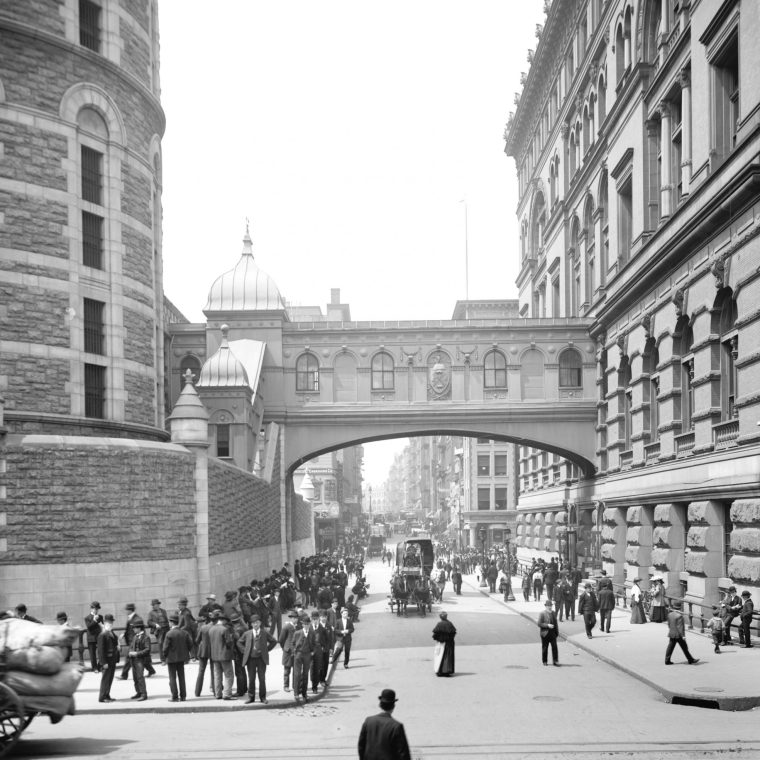

The New York buildings above are both long gone, as is the bridge. That’s the 1902 second Tombs on the left* and the 1894 Criminal Courts Building** on the right; the bridge between them was to allow prisoners to be transported to and from court without going into the street. The arch is purely decorative: the bridge structure consisted of steel beams. Both buildings were replaced by the current Criminal Court Building – the third Tombs – built in 1941.
The. bridge was commonly referred to as the Bridge of Sighs. It’s a somewhat obvious joke: the original Bridge of Sighs connects a prison to the Doge’s Palace in Venice, and was the route that convicted prisoners took to their cells. The original also has an arch below for the simple reason that it is a masonry-arch bridge. There are any number of small bridges over streets in New York, but the one at the Tombs is the most famous.
There is a bridge connecting the Allegheny County Courthouse in Pittsburgh to a prison across the street.

That may be a masonry arch bridge or the arch may be for show. The bridge profile is even closer to the Venice original than the New York bridge. Oh, and the Pittsburgh structure is called the Bridge of Sighs.
Wikipedia also lists the name “Bridge of Sighs” for bridges connected to courthouses in Reno, Nevada, and Santa Barbara, California. There are at least three bridges with that nickname in England, one connected to a courthouse and one to a jail, and at least four others in Europe, excluding the Venice original. I’d guess there are, or have been, more. Using that name for a short-span enclosed pedestrian bridge saves the trouble of thinking up a new one.
* The first City Prison was built in a (bizarre and wildly inaccurate) Egyptian revival style, hence “Tombs.”
** Depending on how you want to count, that’s maybe the third Criminal Courts building, maybe the fourth or fifth.
You must be logged in to post a comment.