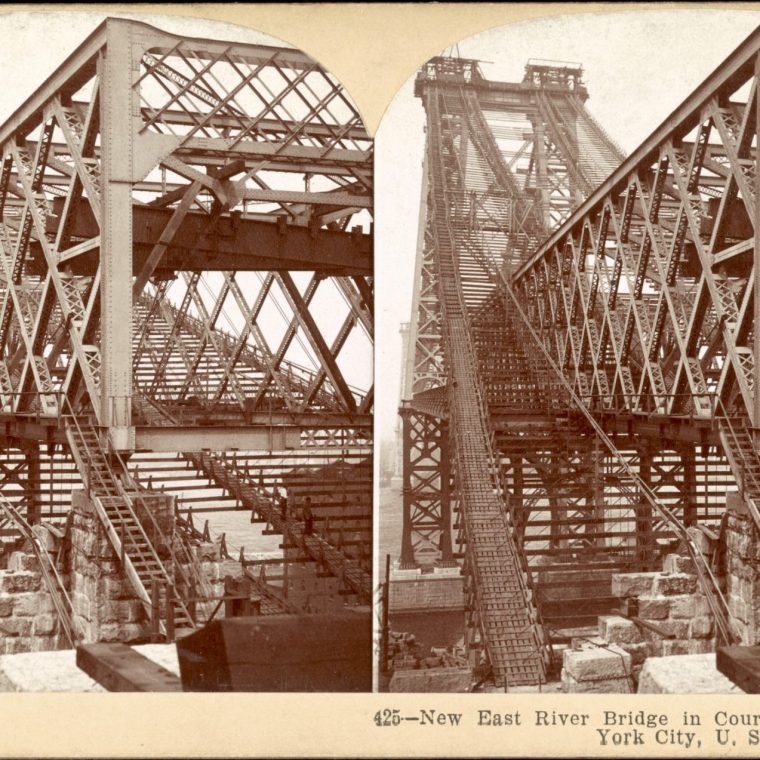

This 1901 stereoscopic view of the Williamsburg Bridge under construction is, in engineering terms, nothing that special. The cable work was long since completed, the main trusses were almost done, and the framing for the two decks was in progress. This picture is far less dramatic than the one I posted this spring, where the main span was still in the works. My opinion of the bridge hasn’t changed since then: it’s easily the ugliest major bridge in a city full of good-looking bridges. But that photo…
You’ve got the cross-braced grid of the main trusses in the foreground. You’ve got the cross-braced grid of the tower in the background. Nearly every member in the trusses and tower is itself built-up with cross-braced steel lattices. You’ve got the walkway, with its grid of planks and stringers, up the leftmost main cable. You’ve got the stair in the bottom center with its grid of stringers and treads. And then below and behind the stair you’ve got the massive ashlar blocks of the anchorage.
I looked at this picture and it felt so familiar even though I’d never seen it before. Oh yeah:

Giovanni Battista Piranesi first published his Carceri d’invenzione (Imaginary prisons) in 1750, then reworked the engravings and republished them in 1761. This is the 1761 version of Plate VII. It’s my favorite of the carceri engravings. And it’s my reference for construction geometry run amok.
You must be logged in to post a comment.