

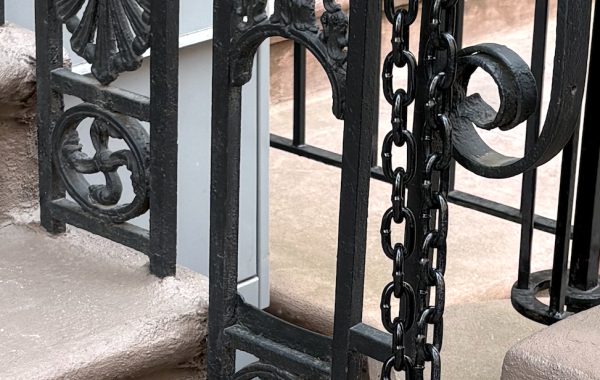
The picture above is not the building I’ll be talking about. It was simply the first one I came to in my collection that had bearing masonry arches. The building I’m talking about will remain nameless: it was large, owned by a non-profit institution, and located in upstate New York, and it was demolished some years ago for no good reason.
The building was demolished because its owners thought it was unstable, and they thought it was unstable because an engineer was very concerned about some cracks. But for this to make sense, I’ll start at the beginning. The building in the photo above has stone and metal lintels in the brick bearing walls except at the top floor, where those big arches carry the brick above and the roof loads. As is reasonably well known, arches work in compression, and they create some degree of horizontal thrust at their ends. Engineers being who we are, we often draw the line of compression at an aches ends with two forces from the arch, one horizontal and one vertical. That’s not wrong per se, but if you measured the stresses within the masonry, you wouldn’t see forces aligned with a cartesian coordinate grid, you’d see a thrust diagonally downward. Here’s an incredibly crude diagram:

The blue arrow represents the load from the wall above the arch and whatever roof load this wall is carrying. It’s straight down, following the pull of gravity. The green arrow represents the arch end thrust: it’s diagonally down because it’s a combination of the gravity load from the weight above the arch and the horizontal push created by the arch compression following a curve something like the curve of the brick. The resultant force (the vector sum of those two forces) is represented by the red arrow, where the diagonal is reduced by the addition of the vertical weight. As long as the resultants are kept within the body of the masonry, the arch and wall will function as expected. The is a good place to mention that, back when masons were building arches in every brick and stone building, it was understood that you might have to add weight to the end piers of a wall to make them work properly.
The unfortunate building I’m taking about had been mothballed for some time, with no maintenance taking place. It had arched window headers at every floor and a tall and thick parapet. During the years of neglect, the mortar joints in the parapet eroded, leading to some small shifting, on the order of half an inch or less for a 16-inch thick parapet. From there, the chain of events resembles a horror movie: the owner panicked that the wall might be unstable and about to collapse, and hired an engineer to investigate. The engineer recommended cutting the parapet from seven feet down to one foot above the roof, which he believed was cheaper than masonry repair, in order to reduce the risk of loose material falling. Shortly after the removals were complete, cracks were discovered in the end piers at the top floor, suggesting outward movement of the piers. The same engineer came to the conclusion that this was proof that the whole building was unstable, and presented the owner with the choices of millions of dollars of “improvements” (specifically, constructing a new reinforced-concrete-block wall inboard of the existing wall, and tying the two together with thousands of pins) or demolition. The building was taken down a couple of months later.
I’ve telegraphed the punchline, of course. The removals of dead load from the top of the building moved the resultant force from the end arches at the top floor outside of the end piers, causing the cracks. (Note that the arch thrust is the same at every floor, but the gravity load increases linearly from a minimum at the top floor to a maximum at the ground floor, so any problem with the resultant forces would be found at the top first.) The solution to the original problem was to spend a few thousand dollars on pointing the mortar joints; the solution to the new cracks was to rebuild the parapets to get the dead load back. Even that would have been far cheaper than demolition, and the end result would have been a standing building rather than an empty lot.
Basic issues involving arches are pretty easy to understand. (Like all structure, you can find examples as complicated as you want.) The problem is not that the engineer in question was dumb, the problem was that he really didn’t understand masonry arches and didn’t know what he didn’t know. If you’re trained solely in modern design, the idea of adding load to a wall to strengthen it will likely never occur to you. There’s an assumption I’ve come across, not often but repeatedly, that obsolete structure was necessarily simpler than modern, and therefore if you understand new buildings, you can immediately understand old ones. It’s wrong.
You must be logged in to post a comment.