
There are aspects of changes in building technology that really play with the idea of “eras” of construction. Once a new technology has been successfully used, it may be used again. (Almost any modern building technology can serve as an example.) Or it may not. (The hybrid wrought-iron and reinforced concrete oddity of the Ward House is a good example, as is the use of long-span open-web steel joists in high rises at the original World Trade Center.) And if it is used again, it may grow in popularity until it becomes one of the dominant ways of building (again, almost any modern building technology), or it may be popular for a whole and then fade away (cast iron is a good example).
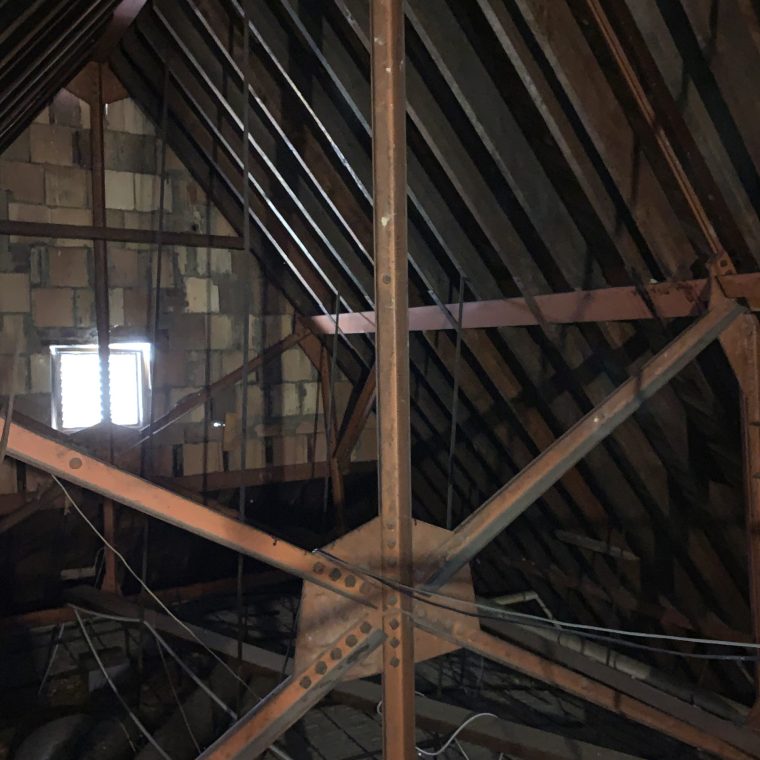
The picture above was taken in the attic of a large commercial 1910s building on Long Island. The outside of the building has a historicist rustic style, include (obviously) high gable roofs. By 1910, it was possible to construct amazing things using steel framing, but most of this low-rise structure consists of wood joists and brick bearing walls…which is what makes those steel trusses interesting. The length of a rafter running from the gable ridge to the eave would have been over 20 feet, and that’s a problem. The steep angle minimizes snow load but catches a lot of wind, and the use of slate on the roof means that there’s always been a high dead load. Wood rafters running the full length would have to be very large or would be likely to gradually sag in the middle, causing visible concavity in the roof.
There’s an obvious solution: run steel beams horizontally halfway between the ridge and the eave, breaking that long rafter span in two. The horizontal red-brown stripe is the flange of such a beam. The flange of a similar beam can be seen at the ridge. So far so good, but now you’ve got support those three (ridge and halfway on each side) beams. The designer used a gable truss made of double angles, with verticals directly below each of the beams, a horizontal bottom chord above the ceiling for the finished space below, and top chords in the same plane as the rafters. (You can just make out the top chord, two rafters in from the upper right corner of the photo.) The truss came partly pre-fabricated – the riveted connections were made in the shop and the bolted connections were made on site. Riveting, like welding, is best not performed around wood structure unless there’s no other choice.
The use of steel does not in any way match the architectural image of the building or the general structural system. It was also a good solution to a design problem and probably less expensive than finding a bunch of heavy timbers to use as rafters. I doubt anyone gave it a second thought: once steel framing was established as a legitimate form of building technology, which happened more than twenty years before this building was constructed, there was no reason not to use it other than a truly misguided belief in purity. So why was I surprised to find steel in the attic? Because, like nearly everyone I know, I’ve internalized a belief that there are distinct eras in construction rather than overlapping and intertwined technologies.