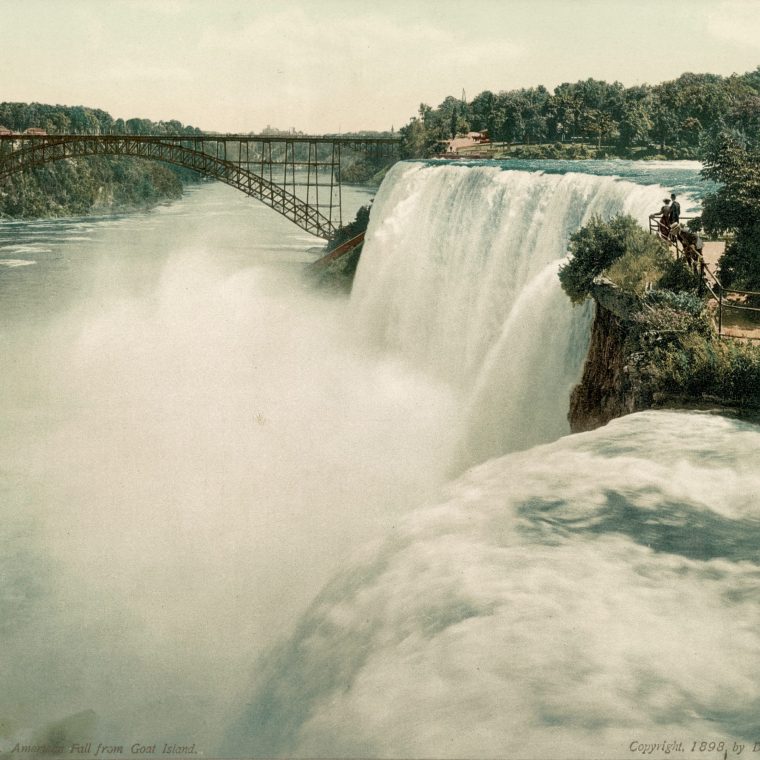

If the setting is dramatic enough, any bridge will look good. That’s the 1898 Upper Steel Arch Bridge connecting the towns of Niagara Falls, New York, and Niagara Falls, Ontario. The caption says the shot was taken from Goat Island, which separates the American Falls from the Canadian Falls, but then I’m not sure what the piece of land those people are standing on is. It might be Luna Island, if the west (downstream) end of the island has eroded considerably in the 120 years since the shot. Any way, here’s a less dramatic but clearer view of the bridge:

The bridge has an excellent pedigree: designed by Leffert Buck – best known among people in NYC as the designer of Williamsburgh Bridge – and constructed by the Pencoyd Bridge (AKA Pencoyd Iron), a company that became part of the American Bridge conglomerate in 1900. It’s a heavy two-hinged arch with a much lighter superstructure above. I personally dislike the fishbelly arch on the right, which is part of the American-side approach: I’m sure it was competently designed, but it visually clashes with the main arch and the grid of the superstructure. In any case, this issue became moot when the bridge collapsed in 1938.
Actual geography and human-made borders always differ in interesting ways; at Niagara, Canada is west of the United States, and the Niagara River is flowing more or less north, from Lake Erie to Lake Ontario. The downstream end of the river, at Lake Ontario, is actually a bit west of the upstream end, even though the overall flow is, of course, west to east from Lake Superior to the Saint Lawrence River. The Great Lakes, being freshwater in a climate that get quite cold in winter, have issues with ice. At its worst, the ice cover in the lakes approaches 100 percent, while warm winters may have only 10 to 15 percent ice cover. For structural engineers, the issue comes when ice is caught in a current, and serves to transfer water pressure to objects and structures well above the water line. The bridge was only a few hundred feet downstream of Niagara Falls, so any appreciable amount of ice coming over the falls would likely start to bunch up near the arch abutments. This happened in 1899, when the structure still had that new-bridge smell, after which stone wing walls were erected to protect the abutments. In 1938, a reported 100-foot high ice jam pushed the bridge over.
The replacement – the Rainbow Bridge – is further downstream, and has its abutments both further inland (that is, away from the water) and higher.

[Image from here: https://commons.wikimedia.org/wiki/File:Rainbow_Bridge.jpg%5D
In theory, the original bridge could have been designed to withstand ice pressure. The steel structure could have been reinforced for it and the abutments better protected. But moving the bridge further from potential ice build-up at the foot of the falls, and moving the abutments horizontally and vertically away from potential ice is also a form of design, and one that is less expensive and less visually intrusive than designing for raw strength.



Permalink