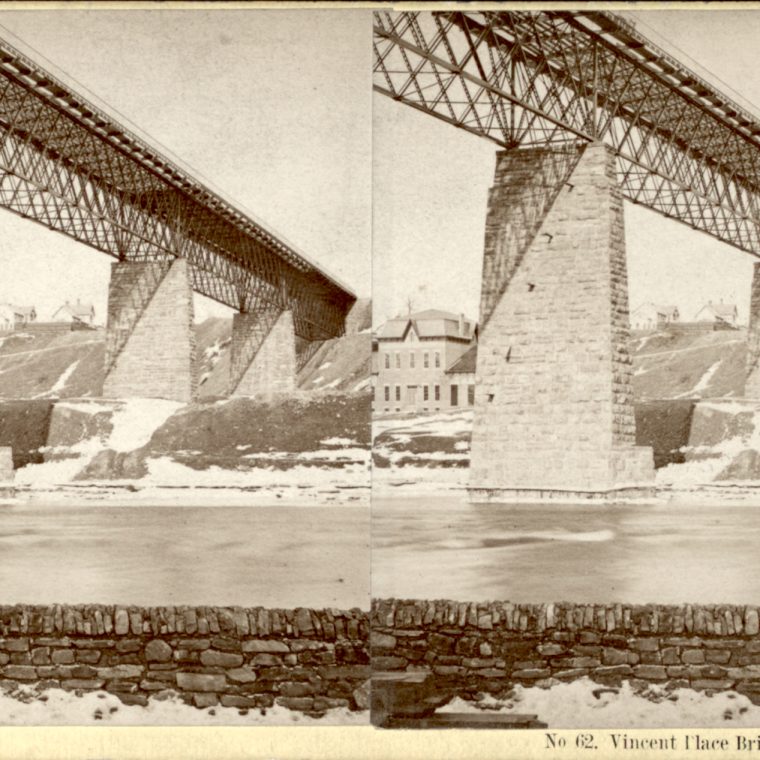

As long as I’m talking about the Genesee River, I should point out that there are a number of historic bridges over it downstream from Portage, particularly where it flows through central Rochester on the way to Lake Ontario. The road bridge above was originally called the Vincent Place Bridge after a street parallel to the river but was at some point renamed the Smith Street Bridge for the street perpendicular to the river that led up to it. It’s a wrought-iron deck truss, constructed in 1873. It was reinforced in 1892, apparently by having a third truss added inside the box made up of the two main trusses, the deck, and the lower-chord wind bracing. (One source says that the 1892 work was adding a second truss, but I have a hard time imagining an 1873 truss bridge with only one truss.) It was dismantled in 1930 and replaced in 1931 by the current bridge at Smith Street, the Bausch Memorial Bridge.

In one sense, this is a very simple bridge. Thanks to the deep river gorge, the trusses run straight across the piers, making the gross geometry as simple as possible. The lattice truss form de-emphasizes any individual member, to the point where it’s tempting to simply model the entire bridge as an ordinary beam. The distinction between massive masonry piers and the airy trusswork, which is common in bridges built between 1870 and 1890, is emphasized here.
Seen up close, the members are built up, so the actual geometry is quite complex, but that doesn’t change the impression that you would get from a distance. For me, this feels like the archetype of a truss bridge, instantly understandable by anyone looking at it. Truss bridges that have profiles complicated by changes in depth – cantilever trusses, bowstring trusses, lenticular trusses, fish-belly trusses – may be clear and readable to engineers, but are often confusing to everyone else. This bridge is, philosophically speaking, not so far from laying a 4×4 over some concrete blocks. If I had to explain a bridge from scratch, this photo might be where I’d start.

You must be logged in to post a comment.