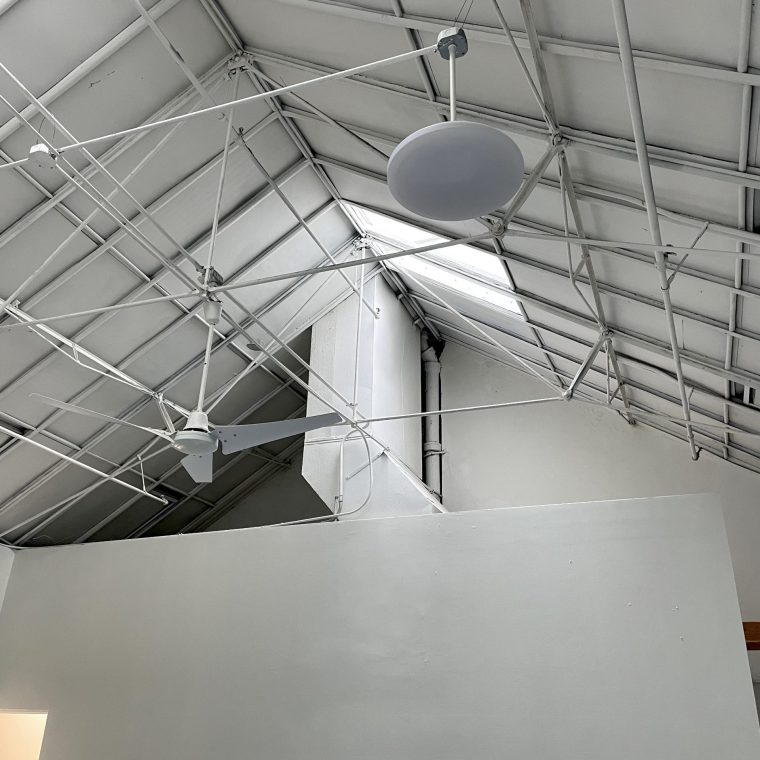

Most of the trusses I’ve talked about are large and carrying heavy loads. There’s nothing that says you can’t use a truss for a 20-foot span and ordinary roof loads, which leads you to the photo above, from an old loft building in Brooklyn. The truss members are mostly bars that are, within an engineering approximation, the same size as the electrical conduit for the lights and fan. (The truss bars are actually slightly smaller, but who’s counting?) I know it can be hard for people not used to looking at this kind of structure, so here’s an annotated version highlighting one truss:

The red lines are round wrought-iron rods forming the lower chord and several web members, the green lines are cruciform cast-iron compression struts as part of the web, and the purple lines are wrought-iron tees forming the upper chord. (The tee shape is obscured by later additions to hold the roof panels.) One member is easy to analyze: the vertical bar in the center (just above the fan) is a sag rod, doing nothing but keeping the horizontal bar at its bottom in a straight line despite gravity’s pull. There are two ways you can think about the rest, both of which are really the same thing. You can look at this as two tension-rod girders following the slope of the roof – each consisting of a tee at the top, the compression strut perpendicular to it, and two rods tying it together – with the horizontal in the middle in tension forcing the two to work together. Or you can look at this as a gable truss with a top chord of the two tees, a bottom chord of the three lowest rods, and a web of the three upper rods and the two struts. Analyze it either way, you’ll get the same answers, so pick the mental model you prefer. Note that the framing running the other direction includes tension-rod girders running truss to truss, in line with the struts.
Because the rods are so small, it’s relatively easy to make true pinned connections at the joints. The end of each rod has been forged into either a hook or an eye (I couldn’t see which) that wraps around a bolt. At the lower connection, the hooks or eyes all line up and a single bolt passes through; at the top connections we have a tine gusset plate to provide a separate bolt for each rod.
This roof, dating from the mid-1800s, is a well-designed system that, given its use in an interior room of an industrial loft, was probably sold on the basis of being inexpensive. And it’s still performing some 160 years later.
In case you think this is a freak one-off, here’s a bigger and much fancier example, meant to be seen by the public, from 1881: the Smithsonian Institution’s Arts & Industry Building. Just about as slender:

Amazing what you can do with sticks.
You must be logged in to post a comment.