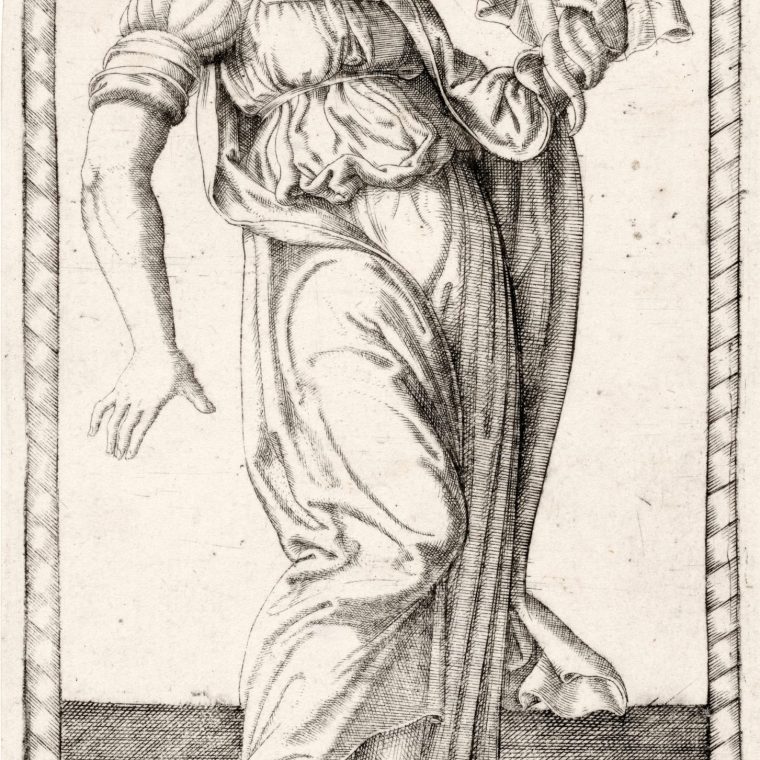

It may not have escaped notice that I wrote five blog posts last week with the word “wasn’t” in their titles.[efn_note] Part 1, Part 2, Part 3, Part 4, and Part 5. [/efn_note] And, of course, I’ve just used a similar construction for the opening sentence today. It’s not the first time I’ve done something like that, either: a little over there years ago I had a four-part series called “What Engineering Is Not.”[efn_note] Part 1, Part 2, Part 3, and Part 4. [/efn_note] One possibility is that I am an unrelievedly negative person, but I deny[efn_note] From The Devil’s Dictionary: DENY, v.t. See HURL BACK THE ALLEGATION.[/efn_note] the charge. The answer is logic[efn_note] The engraved portrait of Logic, above, was created by Andrea Mantegna in the mid sixteenth century. [/efn_note].
If you’re trying to define something that you have some ideas about but really don’t know, negative assessments are much more useful than positive ones. Players of Clue[efn_note] Cluedo outside of North America [/efn_note], Mastermind, and Jotto all know that guesses that result in completely negative answers are the best, because they allow you to eliminate a bunch of possibilities. If the answer to “Colonel Mustard in the Library with a Candlestick” is a shrug, any possibilities with that potential murderer, that potential location, and that potential weapon can be ignored for the rest of the game. If the answer to that guess is to be shown the Candlestick card, you’ve eliminated that weapon but know nothing about the colonel or the library. Note that these games all have a definite context. If guesses in Clue had to include topics other than the murderer, murder location, and weapon, the game would never end: Colonel Mustard in the Library with a Candlestick, wearing Red Trousers and a Panama Hat, while Picking Lunch from His Teeth With a Matchbook…and so on. So this type of logic is dependent on the known context of the problem at hand.
Last week, I was trying to define how an engineer could go wrong by assuming that their predecessors in the past saw buildings in the same way that we see them now. So within the context of comparing current structural forms with past ones, a few simple negative statements are reasonably helpful. Three years ago, I was trying to explain engineering to non-engineers, and within the context of what everybody knows about various professions and activities, a few simple negative statements helped.
There’s another logical[efn_note] ! [/efn_note] extension of the same idea: design itself. Structural engineers working on buildings almost never start with a blank page. Almost all of the time we start with some ideas from an architect. With existing buildings we also start with the existing load paths, materials, and use of the existing structure. That context helps define the problems we deal with enough so that some negative logical statements – won’t casting a new concrete header to support cut wooden joists in a rowhouse be a lot of trouble, expensive, and pointless? – simplify the process of design.