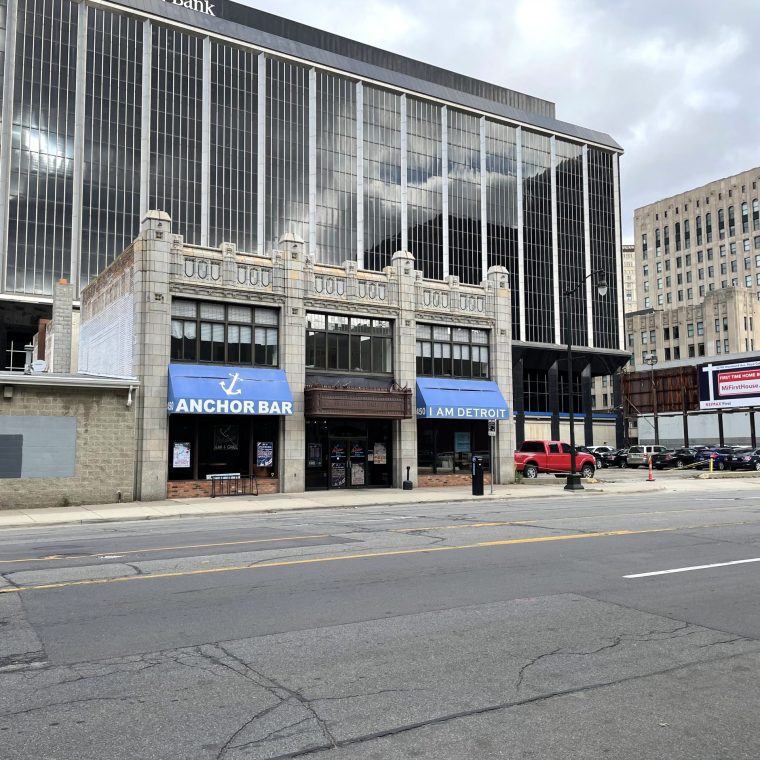

Sometimes it’s easier to see things when you’re unfamiliar with the terrain. I felt like there were a lot of plain lessons about the way cities work visible in downtown Detroit, not necessarily because those issues only exist there but because I don’t know the individual buildings and streets, so I could focus easily on the bigger issues.
The little old commercial building in the foreground of the picture above – the Mercer Building, according to the fantastic sign on the entrance marquee – has, it seems, two commercial spaces at the first floor and offices above. It’s not clear that there are any tenants in the building other than the Anchor Bar. But what’s important is the density, with potentially four or five tenants in a small space. Big buildings, like the one directly behind it, may have more tenants by number, but almost always have a lower density of tenants. This matters for several reasons, including: the failure of one tenant company doesn’t leave a large hole, people leave and arrive at different times of day and so spread out the use of the area, and the small size means that everyone is close to the street. There was a direct correlation between streets that had relatively numerous small retail uses and those that had some foot traffic. Also, the parking lot to the right of the building, while possibly needed in a transit-poor city, contributes nothing to the street.
Here’s an example of a more successful street, Woodward Avenue:

When you see those four old buildings, including three very small ones, surviving while surrounded by newer and bigger buildings, a few things come to mind. First, I wonder if there were separate property owners hostile to one another, which makes it difficult for a developer to assumable a large lot. Second, survival on a major street implies a long history of active use. Third, the three small buildings could only ever have very small retail spaces. As it happens, the dark-red building with the big arch at the second floor is a bar where a bunch of APT engineers ended up one evening, so I have first-hand knowledge that it has taken over the retail space of the taller building to its right. But the point stands.
A downtown with a mix of building sizes, ages, and types is more resilient – in the economic sense – than one that it is all big new office buildings, or all old factories, or any other monoculture. The problem with redevelopment isn’t building a new building, it’s that the small-scale details are usually lost.
You must be logged in to post a comment.