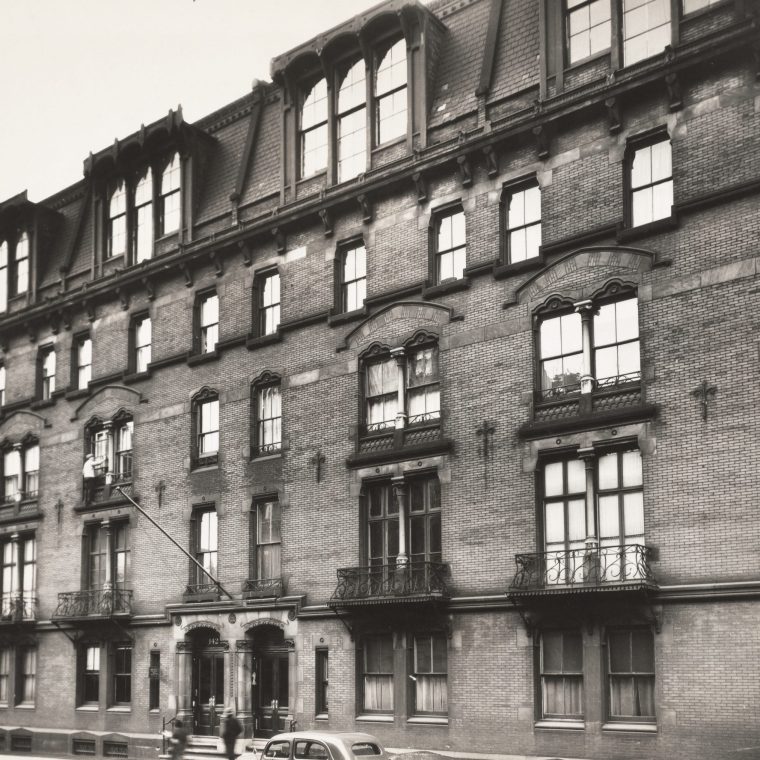

The 1935 picture above, the Stuyvesant Apartments at 142 East 18th Street, is one of the more boring shots from Berenice Abbott’s “Changing New York” project. It’s a fairly straightforward view of the fairly boring street facade of the building, quite similar in appearance to the facade photo taken a year earlier for the HABS survey of the building. Abbott labelled it “Oldest apartment house in New York City, 142 East 18th Street” but, like many other “firsts” that’s stretching things quite a bit.
The discussion boils down to semantics, as this kind of thing usually does. What’s an “apartment house”? It’s something other than a “boarding house”, where people rented individual rooms from someone who owned or rented an entire house. Borders might have meals included in their rent, which would be eaten in the house’s dining room, i.e., communally. Boarding houses have been around in New York since the early colonial days.
Is an apartment house something other than a tenement? A rental unit in a tenement is a single apartment, usually with multiple rooms. And, if we want to get all nit-picky, the law that governed the construction of the Stuyvesant was the first (1867) version of the state Tenement Law. The building greatly exceeded the requirements of that law, but that doesn’t mean it was exempt from it. To get even more nit-picky, this building, and nearly all of the buildings housing apartments in the city were legally “tenements” well into the twentieth century. The buildings that were not were “hotels,” which meant they couldn’t have full kitchens in the apartments. I lived for several years in a 1928 apartment-hotel where all the apartments had “pullman kitchens” (i.e., alcoves roughly 2 feet deep and 5 feet wide) that had mini-fridge (presumably, originally, small ice-boxes) and two electric burners (presumably, originally, hot-plates). There have been tenements in New York since the early nineteenth century, first converted from other building types (such as houses) and later purpose-built. The reason that the tenements laws were put into effect after the Civil War was that the tremendous population growth of the city was leading to developers building packing crates for people and calling them tenements: buildings where there were no windows for most of the rooms and no toilet facilities worth mentioning. That last item is maybe a place we can distinguish between a tenement and an apartment house: many tenements still had privies in the rear yards, while buildings called apartment hoses typically had something like modern bathrooms. Here’s the HABS plan of the first floor of the Stuyvesant, with the bath at the rear of each of the four apartments:

But that’s still not a good distinction because some tenements did have decent bathrooms. And the Stuyvesant, with some bedrooms measuring six feet by ten feet, was hardly exempt from the pack-them-in mentality of the era. Those long hallways, 3 feet, 3 inches wide, were claustrophobic by any measure other than the New York tenements of the era, and the court was fine but not really any more spacious than the rear yards of tenements:

Every morality tale needs a hero and a villain, and the history of housing in New York is no exception. Pre-Old-Law and Old Law tenements are the villains, and the Stuyvesant prefigures the hero: the New Law tenements of 1901 and later. The plan of the Stuyvesant is close to a popular style of apartment built the 1901 law, although the rear yard and courtyards are smaller than that law required.


You must be logged in to post a comment.