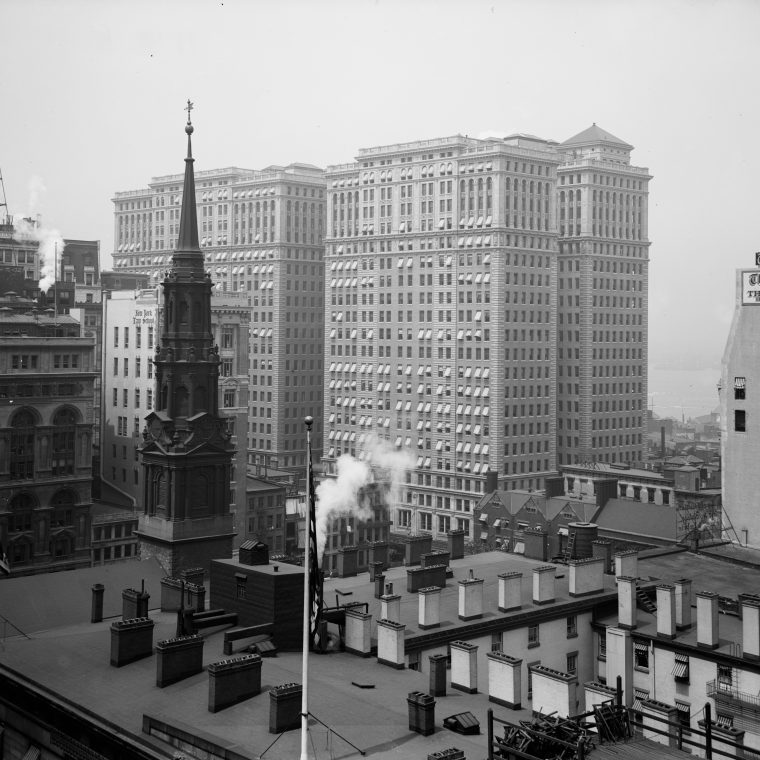

If that circa 1910 picture above is hard to place, it’s because so much has changed in that specific area. The church is St. Paul’s Chapel and we’re looking southwest, but that’s where easy-to-recognize ends. The building on the near right is the Astor House hotel from 1836, which explains why there are so many chimneys. When that hotel opened, rooms were heated by fireplaces and stoves. The two big buildings are the Hudson Terminal, the NYC end of the Hudson & Manhattan Railroad. That railroad – a subway, really – was constructed to connect the main-line railroad terminals in New Jersey to New York, as well as provide commuters with an alternate to ferries. Under its new name, the Port Authority Trans-Hudson line (PATH), it’s still doing that. The terminal building was demolished to help create the site for the original World Trade Center.
I was walking through the other day and I started thinking about how much the mass transportation there has changed. There have been four subway lines serving that spot as long as I can remember – the IRT (the 1 train, Seventh Avenue local), the BMT (R train, Broadway local), the IND (E train, Eighth Avenue local), and the PATH – but saying it that way is a form of presentism. If we start in 1908, 115 years ago, the amount of time where all four lines were operating simultaneously is less than you’d think.
- 1908, the Hudson Terminal Building opened.
- 1909, H&M service from Jersey City to the Hudson Terminal began.
- 1918, BMT Broadway service began serving the Cortland Street station under Church Street.
- 1918, IRT Seventh Avenue service began serving the other Cortland Street station under Greenwich Street.
- 1932, IND Eighth Avenue service began serving the Hudson Terminal station (now the World Trade Center station) under Church Street.
- 1971, the H&M station was moved about a block west.
- 1972, Hudson Terminal building was demolished.
- 2001, IRT service at Cortland Street was suspended.
- 2001, BMT service at Cortland Street was suspended.
- 2001, PATH service (on the downtown branch) was suspended.
- 2003, PATH service resumed at a temporary station.
- 2005, BMT service at Cortlandt Street resumed.
- 2018, IRT service at Cortlandt Street resumed.
To put it another way:
- 1909-1918, H&M service only.
- 1918-1932, H&M, IRT, BMT service.
- 1932-2001, H&M/(renamed PATH), IRT, BMT, IND service.
- 2001-2003, IND service only.
- 2003-2005, PATH and IND service.
- 2005-2018, PATH, BMT, and IND service.
- 2018-present, PATH, IRT, BMT, IND service.
Out of 114 years since the first station opened, only 74 years have had all four lines operating simultaneously. There’s no great mystery as to why: the lines opened at different times, and three were shut for various lengths of time by the disruption of the site by 9-11. But my mental image, of four liens here, is not really correct. It true now, and was true when I learned the area, but it has come and gone. And I spent the time documenting this because there’s an obvious parallel to the history of the buildings we work on. What we see now is a snapshot that may not represent the timeline very well.