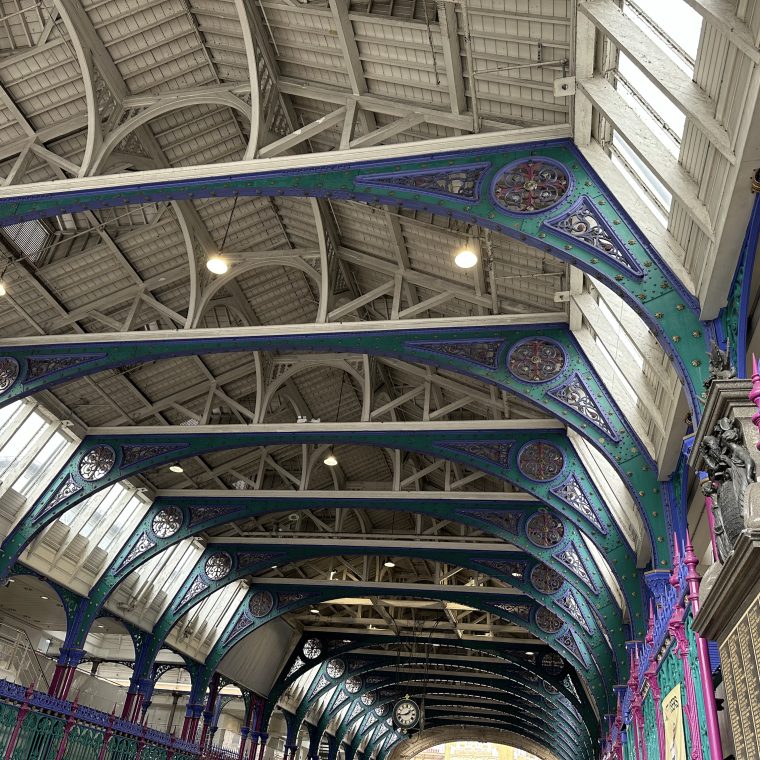

That remarkable roof is part of the Smithfield Market in London, constructed in the 1860s. I’m reasonably sure that the green and dark blue elements are wrought iron, riveted together, the gray and red ornament is cast iron, and the light gray roof structure is wood. Whether or not the high-victorian style is to your taste – and it is rather busy and fussy – it’s a remarkable roof. It’s more remarkable when you consider that this space below is a meat market, a modernization of the market that has been on that site since before the year 1200.
Fundamentally and technologically, that roof is closer to what might be built today – a long-span roof in steel, concrete, or glulam – than it is to its medieval stylistic precedents. The metal work was not mass-produced, but it was made using industrial processes that allow for replication of forms. The wood was similar fabricated using powered tools that allow for exact replication of decorative designs and the creation of many identical sticks. Building this roof required skill and knowledge, but those of industrial fabrication and erection, not those of traditional crafts.
I’ve stolen the title of this blog post from Walter Benjamin for a reason. The break in the history of structures didn’t happen when engineers got involved, or when any specific material entered use. It happened when craft techniques, some of them extraordinarily sophisticated (google “stereotomy”), were replaced with industrial techniques. This not only allowed the use of iron, steel, and concrete, it allowed for advances in masonry and wood construction. The use of high-strength metals encouraged structural design by engineers rather than architects, builders, and rules of thumb; it allowed for roofs like the Smithfield Market to become commonplace.