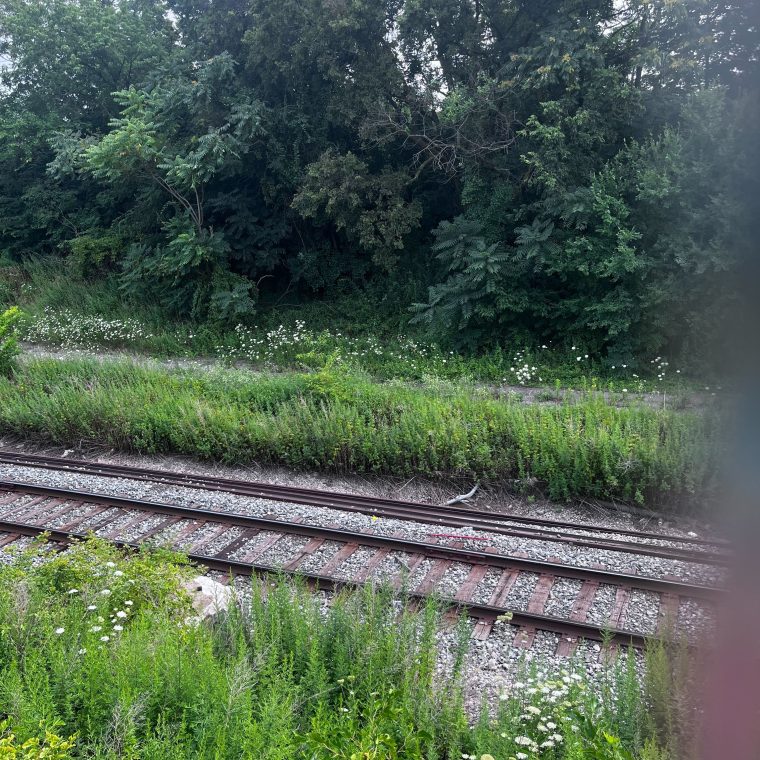

Eleni Retzepis, now a summer intern at OSE and soon headed for her last year as an undergrad, took the picture above from the window of an N train near the Fort Hamilton Parkway station. She thought that the “ghost track” might have a history worth writing about, and she was correct. Those tracks are technically not dead, although it’s close. There’s maybe one diesel freight train per day along that line – the Long Island Railroad’s Bay Ridge Branch – that once had electric service and 17 stations.
The Bay Ridge Branch was first built to address one real problem and one possibly-imaginary problem. The real problem was getting freight across New York Harbor between New Jersey and Long Island. To this day, that’s done using car floats (barges that carry freight cars) or the freight is transferred to trucks and driven. The Bay Ridge waterfront terminal of the line provided a straight-line barge route to the Jersey City rail yards. When the Port Authority was created in the 1920s, it was supposed to build a freight tunnel, but that was sidelined in favor of the truck method.
The imaginary problem can best be explained using the 1878 map below:

The dashed lines in the north were existing elevated trains in the city of Brooklyn. The Bay Ridge branch is the New York, Bayridge [sic] and Jamaica Railroad, not yet absorbed into the LIRR empire. The NYBR&J, combined with the miniature New York & Manhattan Beach Railroad, gave a way for people in New York to get to the beaches at the south end of Kings County without going through the heavily built-up portions of Brooklyn, which were then still to the north of Prospect Park. New Yorkers could catch a ferry along the Hudson, get on the train at Bay Ridge, and go to the beach without having to see central Brooklyn up close.
At about the same time, another steam railroad, the New York and Sea Beach Railroad, was built immediately adjacent to portions of the NYBR&J, curving south to head to Coney Island. After a long and frankly boring history of changes in service and ownership, it was rebuilt as an elevated mass transit line, connecting to the Fourth Avenue subway that was a major portion of the 1910s “Dual Contracts” subway expansion. That’s the current N train.
The abandonment of passenger traffic on the Bay Ridge branch in the 1920s, and the gradual decline of freight traffic through the twentieth century, explain the current state of the line. However, it’s part of the proposal for Interborough Express, a new light-rail mass-transit line that would connect nearly every subway line in Brooklyn and Queens by running circumferential, along this route, as opposed to radial layout of the subway lines.
So Eleni’s view from the elevated N is now a semi-abandoned freight railroad that was once the main passenger line in the area, and may one day be a light-rail complement to the subway.
You must be logged in to post a comment.