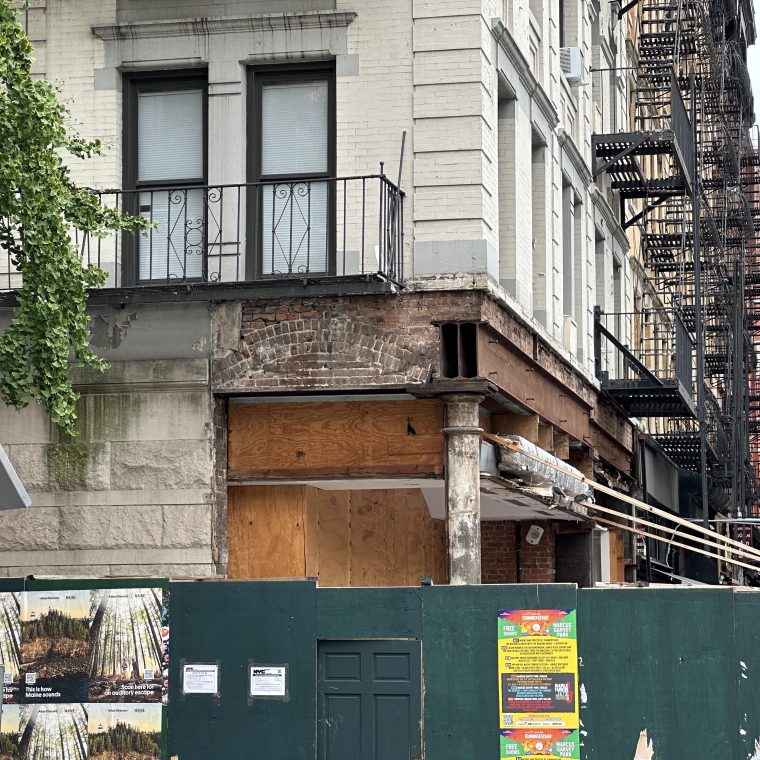

The lintels over the storefront of a (probably) 1890s tenement were exposed during construction (not by us, as it’s not our project). On the side street north facade, on the left, an arch over a short opening for a relatively small piece of storefront; on the right a triple-I-beam lintel that runs more than halfway across the building’s width on the avenue. Underneath, a cast-iron column.
The side wall with the arch is a bearing wall, supporting the floor joists above, and the arch is right next to the corner. So this piece of wall is reasonably heavily loaded and there’s no mass to the right to take the arch thrust. If you zoom in on the photo, you’ll see (a) a solid dark line below the brick infill below the arch and (b) a diagonal line at the right end of the arch, just to the left of the triple I-beam. That’s an iron plate which serves to hold the infill, with would otherwise not be self-supporting and, more importantly, provides a tie for the arch. The diagonal line is part of the plate and it provides a bearing end for the arch – in the old construction terminology, a “skewback” – that transfers the arch thrust to the horizontal part of the plate. The pair of skewbacks and the horizontal serve to provide a tie for the arch, so that the brick arch and the iron plate together are a lintel with no thrust.
There are two reasons for the triple I-beam. This was built before wide-flange beams existed, so even if a single I beam was strong enough for the load, its top flange would be too narrow to carry the wall. Second, a single I beam wasn’t strong enough. It looks like the I beams change depth halfway across the building, but that’s just a separate span for the southern half of the facade.