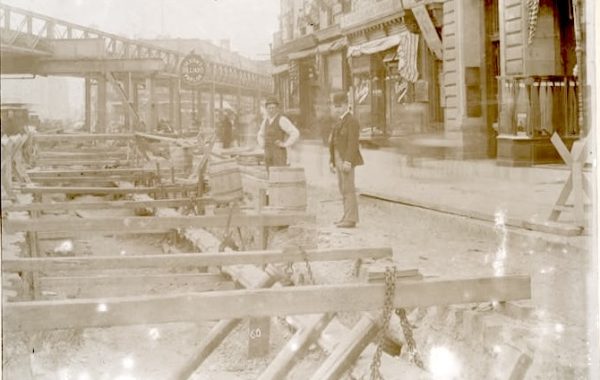
Another view of the St. Regis Hotel under construction in 1901, this time looking west on 55th Street from a point east of Fifth Avenue. The steel frame is only a few floors out of the ground, and provides a nice contrast in technology to the horse-drawn vehicles.
The frame also has a detail that you rarely see: the columns have been erected in three-story sections. The floor framing is in place for the second and third floors, but the single-piece columns that have been erected above the third-floor column splices extend past the four and fifth floors to splices above the sixth floor. Counting is made easier by the fourth- and fifth-floor spandrel beams that have been erected, making one pair of columns into a big ladder.
When “metal framing” meant cast-iron columns and wrought-iron beams, thirty years before this photo, columns came in single-story sections. Steel framing eventually settled on two-story column sections as the most common length. That’s a compromise between having to create splices at every floor, and having columns more than 30 feet long, which would be annoying to transport and erect. In an ordinary steel-frame building constructed between 1920 and 1960, nearly all of the beams would be 25 feet long or shorter and so would two-story columns. So three-story column sections, as seen here, are an oddity.
The other thing that jumps out at me from this photo is how much the wood sidewalk bridge looks like a modern sidewalk bridge. Posts, cross-bracing along the street and building sides, and regularly-spaced joists supporting the deck. We’ve kept this design, just substituted metal for wood in all the pieces.