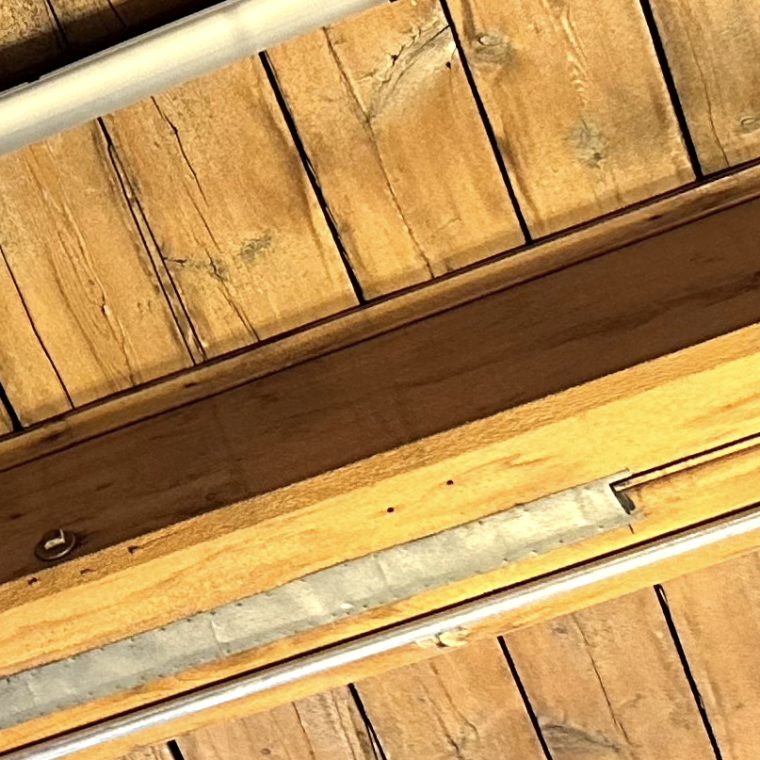

I took this photo last summer while eating dinner in a brew-pub in Utica, New York. I’m looking up at the second-floor framing from below, in an old industrial building near the train tracks (the former main line of the New York Central Railroad). The building structure consists of unreinforced brick bearing walls and heavy timber columns supporting heavy-timber floors. As a reminder, “heavy timber” is what lawyers call a term of art: it doesn’t just mean that there are big timbers involved, it was and is a fire-rated system of construction that can be built using wood.

There are two keys to making the system work. The first is making all of the members big enough so that they can lose some material to char during a fire and still function. Char acts, for a while, as an insulator, so as heat rises during a fire and the bottom of, for example, the girder in the photo starts to burn, it happens slowly. (Another name for heavy-timber construction, more commonly used in the past, is “slow-burning construction.”) That’s the essence of a fire rating: knowing that it will take a certain amount of time before failure occurs during a fire.
The second key is preventing hot air (and the combustion gasses it contains, if it’s above a fire) from passing through the floor. There are two reasons this is so important: to prevent fire spread to the space above, and because hot air passing through gaps in the floor will very quickly destroy that floor and undo the slow-burning concept. The floor may look like ordinary plank but it’s very thick and is either tongue-and-groove (so the tongues run across the potential gaps between the planks) or splined (small planks fit into grooves in both planks, spanning across the gaps).
Almost all structural wood, even if seasoned, shrinks after installation. The inside of a building is simply drier than the outside world. So, no matter how tightly the main edges of the planks may have been touching when the floor was first built, there will eventually be narrow gaps between them. The tongues or splines may not be needed early on, but are after the shrinkage occurs.
One last note: the corners of the girders are chamfered for a similar reason: a right-angle corner would be heated much faster than the flat sides of the beam, while the flatter 135° corners are not as bad.
You must be logged in to post a comment.