
I somehow missed this 1937 photo when I was working my way through Berenice Abbott’s “Changing New York” project last year. It shows the short and isolated stretch of Twelfth Avenue below the Riverside Drive viaduct, between 125th Street and 135th Street. (Because the west end of 125th Street deviates from its proper location in the grid to follow a natural valley, 125th and 130th just about intersect.) I wrote about the viaduct at some length before.

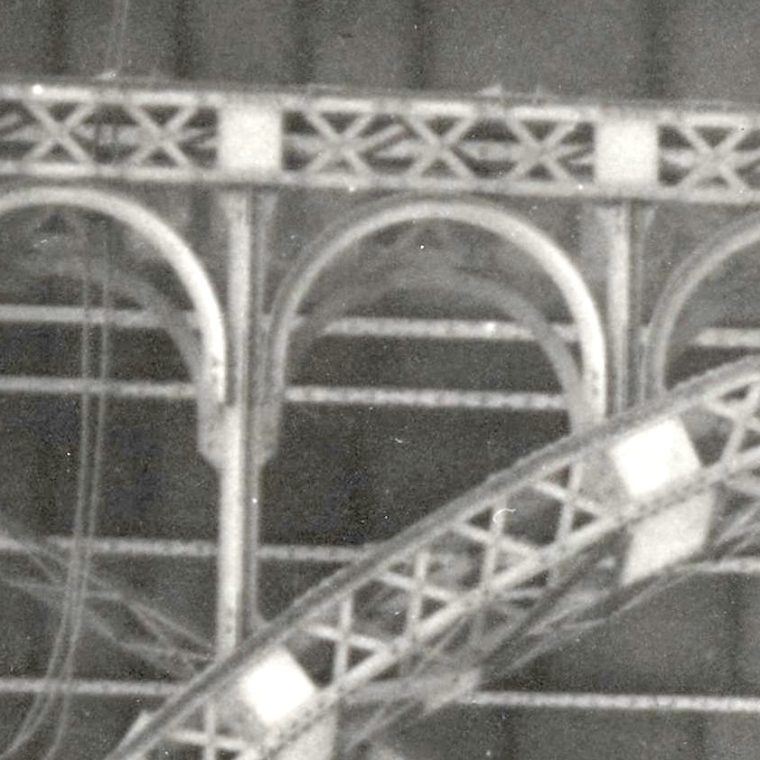
Abbott was looking for contrasts and she found them here. There are several small industrial buildings – because of the valley, this little piece of Twelfth Avenue was the only part of the Hudson shoreline of the Upper West Side that had good access to the river – with wholesale meat close by. There is the huge cylindrical gas holder on the right, with its complex and partially moveable supporting truss-work. And there is the underside of the viaduct. The top of the viaduct is an extension of one of the nicest residential streets in the city; the bottom varies between the straightforward built-up plate girders that are the transverse beams and the lattice arches that support them. The structure could have been more simple, and looked something like a heavier version of an elevated rail line, so it was a specific choice to spend more money for a more ornate structure that is hard to see clearly unless you wander down to Twelfth Avenue with the people buying wholesale meat.
The small buildings could have been built at any time after 1850 and they would have looked much like that. There was little thought given to their design as “architecture” and even less as “structure.” They are vernacular New York small-scale industrial buildings. The gas holder is pure structure, with its shape dictated by the mechanics of storing and releasing combustible gas under pressure, and its structure dictated by the least material necessary to stabilize the curved steel plates that make up the tank proper. And the viaduct is somewhere in between, an engineering structure mostly designed for efficient transfer of loads but modified for visual appeal. When I was talking yesterday about people trying to make a steel structure prettier, this is a good example of what they probably had in mind, but this viaduct is a difficult standard to live up to when you’re constructing dozens of miles of elevated railroad.
You must be logged in to post a comment.