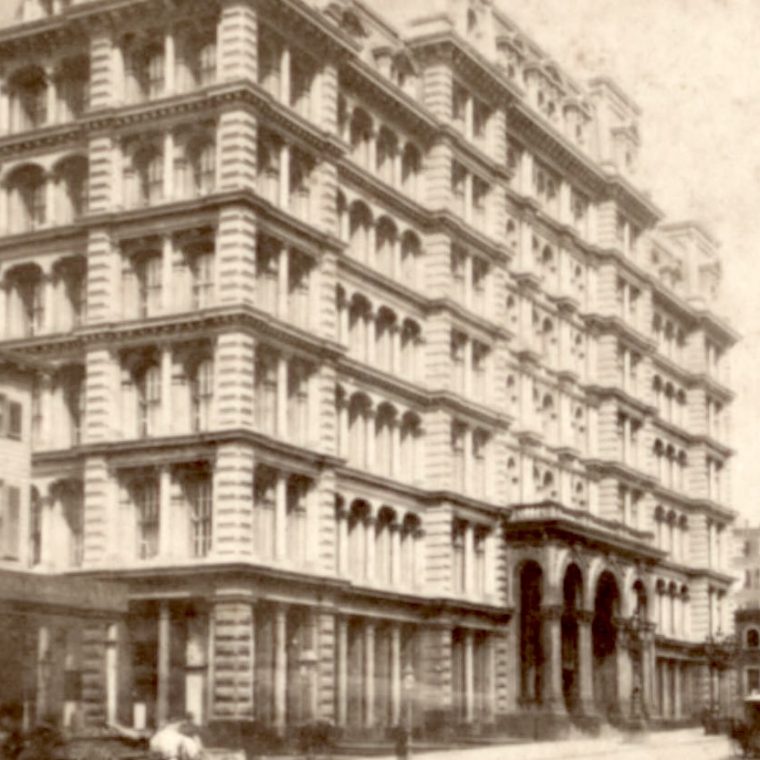

A few years ago, I wrote a fairly snarky and negative piece on the Park Avenue Hotel. The building is physically of interest to me because it was a rare example of a residential building with cast-iron facades and a good example of the common approach (in the mid-nineteenth century) of building a large building as a series of small buildings with doors through their party walls. Here’s an 1879 view of the Fourth Avenue front, long before that stretch of Fourth Avenue was named Park Avenue South:

Nearly all of that intricate facade is cast iron, which if course was used to achieve ornamental styles for less money than stone masonry would cost. Cost was a real issue because this building was not constructed to serve as a commercial hotel. Rather it was “Stewart’s Hotel for Working Women” (there are several variations on that name in the records), planned and built by A. T. Stewart, a department store owner, as a residential hotel for single women supporting themselves.

It was converted to a regular hotel a year after its 1878 opening. Note the nine-year lag from Stewart proposing the hotel until it opened, and the fact that the actual building looked just like the rendering from nine years earlier.
Manhattan used to be full of residential hotels, ranging from actual hotels with monthly rates for long-term tenants, to what are now called SROs with some minor cooking facilities, to buildings that looked very much like apartment houses. When you read descriptions of real estate from the late 1800s, “bachelor hotel” is a tip-off that you’re looking at one of the first two classes, “housekeeping” tells you you’re looking at the third. The reason for this is tied to the tortured history of multiple dwelling in New York. The idea of apartments for people who weren’t poor took a long time to get going, in part because tenements (and pre-tenement conversions of buildings to tenements) had such a bad reputation. Hotels were, at least by reputation, cleaner and safer, even when they weren’t really hotels.

You must be logged in to post a comment.