

I was on my way to a site in Greenwich Village and came across this group at 12th Street and Hudson Street:

This is in the Greenwich Village Historic District, so I knew I could find a capsule history of the buildings with minimal effort, but I took a look at the usual fire maps. In 1895 (rotated to put north at the top), the three houses on the left look about the same, but the tenement at the far right isn’t there:
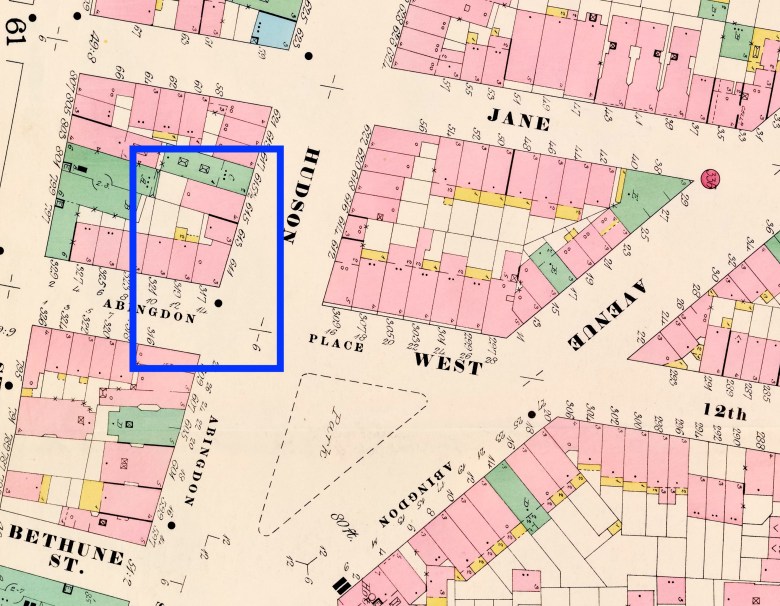
The oldest map I have ready access to is 1854 (also rotated to put north at the top), and shows the two three-story houses on the left with a vacant lot where the four-story house should be:

Note that Troy Street had not yet been renamed as an extension of West 12th Street.
Thirty seconds looking at the historic-district designation report made it all painfully clear: the two three-story houses were built together in 1842, along with a row on West 12th Street (beyond the white-painted house) and the corner house always had a commercial space on the ground floor. The four story house to the north was built in 1859, and the tenement in 1900. A few thoughts:
There were similar houses built all over lower Manhattan in the 1840s and 50s, but in most other areas they’ve long since been replaced. The houses on the lower east side were replaced by tenements or 1950s urban renewal, those along Sixth Avenue were replaced by commercial buildings, and so on. So these houses are interesting not because they were unique but because they survived, which happened because for a long time Greenwich Village was an economic backwater.
Why do these buildings look more than usually old? The two 1842 houses have an ad hoc feel to their facades. They have the architectural elements we expect to see – most obviously, cornices and projecting window lintels and sills – but there are geometric irregularities. The 1859 house feels more thoroughly planned, which the tenement, amusingly, has the most ornate and well-planned facade.
Finally, the white house and the tenement both have cables draped over their facades. Back in the days of no cell phones and a land-line monopoly, New York Telephone (the local branch of AT&T) would go crazy with wires on the rear facades of rowhouses; the spread of cable TV in the 1980s led to this nonsense on front facades as well. It amazes me every time I see it.
You must be logged in to post a comment.