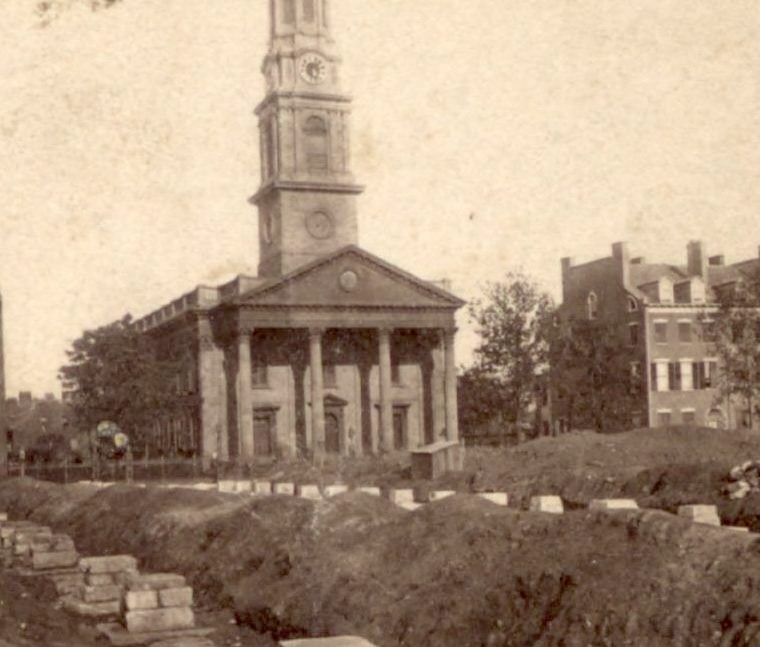

I wrote before about the destruction of St. John’s Park, but I had not seen the photo below. The photo shows St. John’s Chapel, an out-chapel of Trinity Church, which was constructed in 1807 and which eventually gave the park its name.

This was originally an almost suburban setting, with the square city block of the park surrounded by only houses and the church. The location – Laight to Beach Streets, Varick to Hudson Streets – had been a “meadow”, which is the colonial-era New York euphemism for swamp, and like so much of Manhattan it was regraded to be made more readily useable. The relentless growth of the city meant that it went from a far-away location, to fashionable, to unfashionable because of the proximity to industry in less than 50 years. The park was developed by Trinity parish when the church was built, and so it could be sold, and it finally was, in 1866. The New York Central Railroad bought the park as a freight terminal at the south end of the Hudson line, while the passenger traffic went to the more centrally-located Harlem line running down Fourth Avenue. Replacing the park with a large building full of steam engines and horse-drawn vehicles was the absolute end of the neighborhood as any kind of fashionable location, and the houses were gradually converted to boarding houses and replaced by loft buildings.
Take another look at the picture above, which is from 1867. The photographer was standing in the park, facing east to the church, and a series of trenches had recently been dug into the ground, with stone piers built in each trench. Those piers are the foundations of the freight terminal. We’re seeing the moment when the park disappeared. Here’s a roughly similar view in 1890, with the freight terminal – complete with a statue of Cornelius Vanderbilt in the pediment – and the site of the church behind.

The terminal was demolished in the mid-1900s to create an exit plaza for the Holland Tunnel; the exit plaza, which is inaccessible to anyone not in a car coming from New Jersey is technically named “St. John’s Park.”

You must be logged in to post a comment.