
How much can you determine about a building in a minute or two? The short answer is “not much” but sometimes you can get useful information about the structure from the street. It’s certainly easier if you know the history of the area – I am far more efficient at building inspection in New York than I am elsewhere – but a little logic can go a medium-length way.
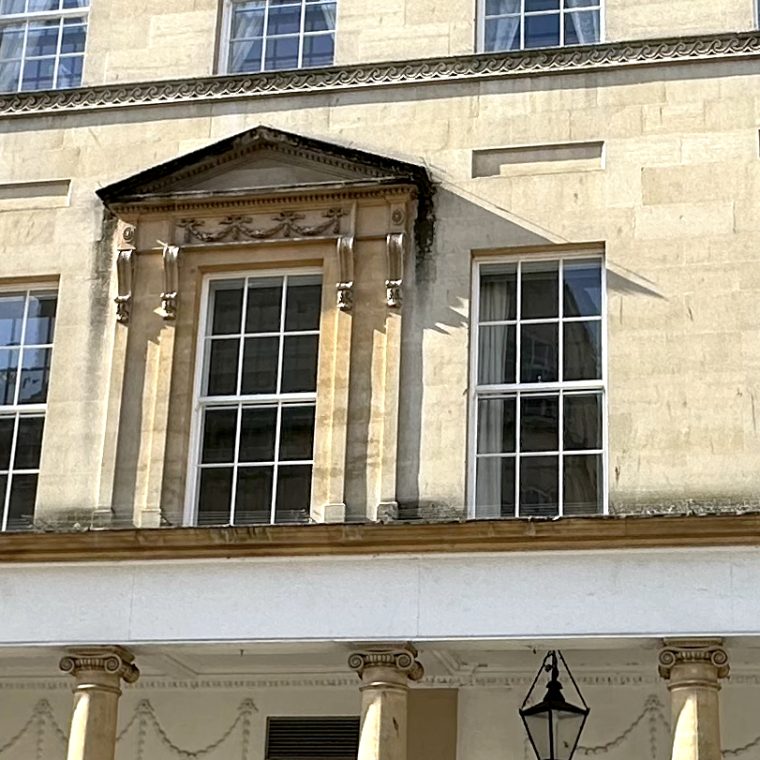
This is 34-36 Stall Street in Bath:

Given that it is a building of some pretension in the downtown area of a city with a lot of heritage buildings, I assumed that I’d be able to find some information about it online. (I did, and it’s at the end.) But what can we infer about the structure just from the front facade?
First, this is a traditionally built building and it has a horrendous soft story at the ground floor. Even if the setback facade where the storefronts are is as good a shear wall as the main facade above the ground floor (and it’s not), the fact that it’s not lined up is a problem. Since this is a three-story building surrounded by similar-size buildings, the wind load on it is negligible, but seismic loading is not subject to shadowing the way wind load is. So my first conclusion, if I’m relying only on observation, is that this is not in an earthquake-prone area. Traditional buildings in areas where people have learned to live with earthquakes rarely have this kind of design.
Second, it’s not as traditional as it looks. The white band above the ground-floor colonnade is a fascia hiding a lintel of some kind, not the lintel itself. You can tell by looking at where the joints are:

If we were looking at the structural lintel in traditional construction, the joints would be centered (or nearly so) on the columns. That fascia may be covering iron beams, or masonry arches, or maybe iron arches.
So, a brief moment on the street, two real facts about the structure. In any case, it’s late 1700s and grade I listed.

You must be logged in to post a comment.