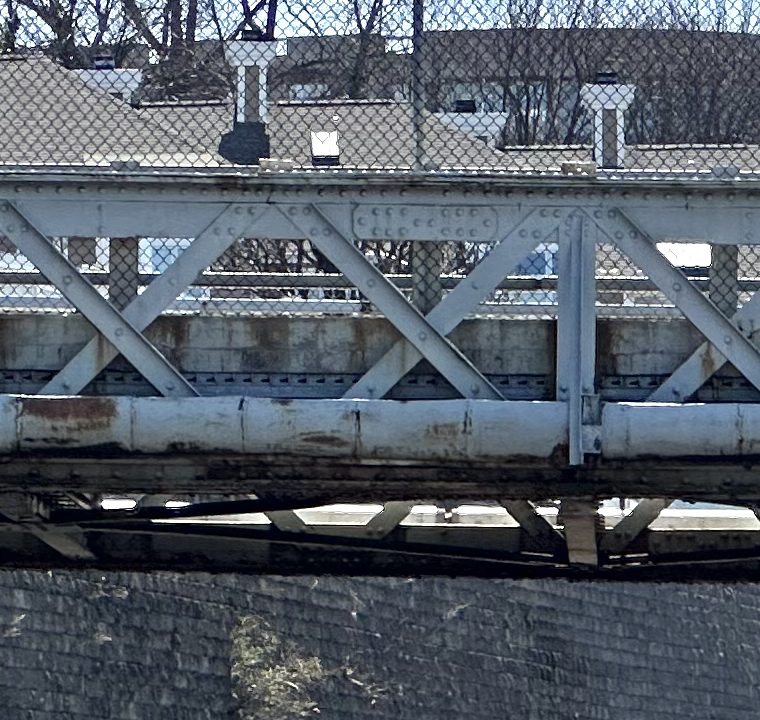

There’s a street bridge over the Hudson Line (the former main line of the New York Central Railroad) tracks just south of the Dobbs Ferry Station:

For now, ignore the big white pipe at the bottom of the side truss: it’s a utility line, not part of the truss. That leaves us with two parallel chords (the bottom chord more or less hidden behind that pipe) and a web consisting of crossed diagonals with a vertical at every other panel point. It’s not a difficult pattern to pick out, but it’s hard to describe because it doesn’t have a name. And it doesn’t have a name because it doesn’t make much sense.
A truss with alternating diagonal web members is a Warren Truss, as first patented in 1846. Warren trusses can have verticals at every panel point or every other panel point. Picture a Warren deck truss, with the roadway at the top chord. Putting verticals at the panel points where the diagonals meet at the bottom chord cuts the length of the span of the top chord as a beam in half; putting verticals at the panel points where the diagonals meet at the top does nothing much. So it makes sense if you’re looking for an ultra-efficient design to include only half of the verticals, to reduce the bending stress in the top chord by 75%. Warren trusses are easy to solve using the old hand-calculation methods (method of joints, and method of sections) which is true of most of the nineteenth-century truss types.
A truss with diagonals in both directions, making an X, in each panel is a Double Warren or Double Intersection Warren. Technically, it’s statically indeterminate, and so can’t be readily solved using the hand-calculation methods, but there’s a simple, almost-accurate assumption that makes it solvable. If you treat the truss as two Warren trusses that just happen to exist at the same time and in the same place, and divide the loads in half between those two imaginary trusses, and treat the top and bottom chords of the two imaginary trusses as half the size of the actual chords, your answer will be very close to the actual, difficult-to-calculate answer. A Double Warren truss can have verticals, but there’s no reason to provide every other vertical, since it doesn’t shorten the span of one of the chords the way it does in a regular Warren. So the truss in the picture isn’t a Double Warren without verticals, and it’s not a Double Warren with verticals. And I suspect that analyzing it with and without those verticals would show little change in the state of stress in the diagonals and the chords.
There’s one reason I can see for this pattern, and it’s not really structural. That big pipe I said to ignore? It needs to be supported, and from what I can tell, the verticals are carrying brackets to support the pipe. I want to say this has been a fairy tale with a moral, but it’s more like a shaggy-dog story with an underwhelming punchline: just because something looks like structure doesn’t mean that it is, and vice versa.


You must be logged in to post a comment.