
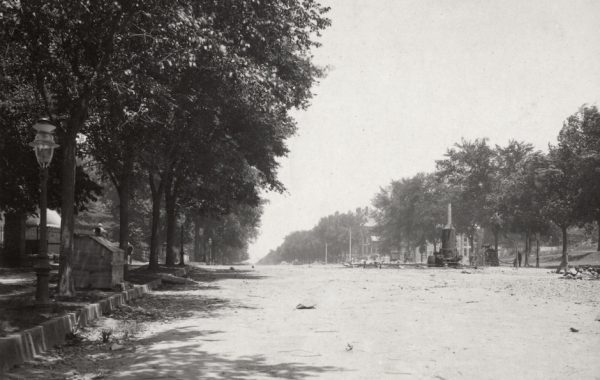
I’ve discussed the old Croton Distributing Reservoir several times before. It was the southernmost visible part of New York’s first really good water system, and occupied the same spot that the New York Public Library does today: 40th to 42nd Street, from Fifth Avenue to a little less than halfway to Sixth. Here are two stereoscopic views from 1865 where it’s not visible but its presence is felt:


That park is Reservoir Square, the leftover land west of the reservoir on the double block. It was never a highly-designed space, like Union Square, and it was a temporary home to the New York Crystal Palace until that burned down. The surrounding part of midtown is best understood, in the mid-nineteenth century, as a mid-distance suburb that was legally part of the city: it was far from the commercial downtown area in travel time, and was almost entirely residential. The construction of Grand Central Depot changed that, a few years after these pictures were taken, but it was a forty to fifty year process for midtown to become fully commericalized.
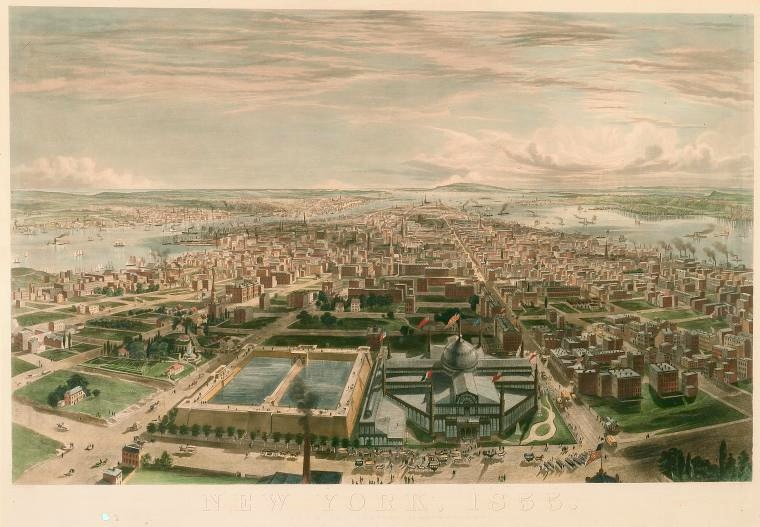
The reservoir loomed over the park physically and to some degree psychically. Photographs and illustrations of the Crystal Palace were almost angled looking south or north, so that the reservoir’s huge bulk didn’t make it look like a toy. Here’s a somewhat impressionistic 1855 view from the Latting Observatory, a wood tower across the street:

The footprints of the two structures are about the same, but the reservoir was solid stone when seen from the street, as opposed to the glass-walled palace. The neighboring buildings to the west (right) are out of scale, painted larger than they actually were.
In short, Reservoir Square was a park by default, land without another use. Not until the library was built, after 1900, was it turned into a properly-designed park.
You must be logged in to post a comment.