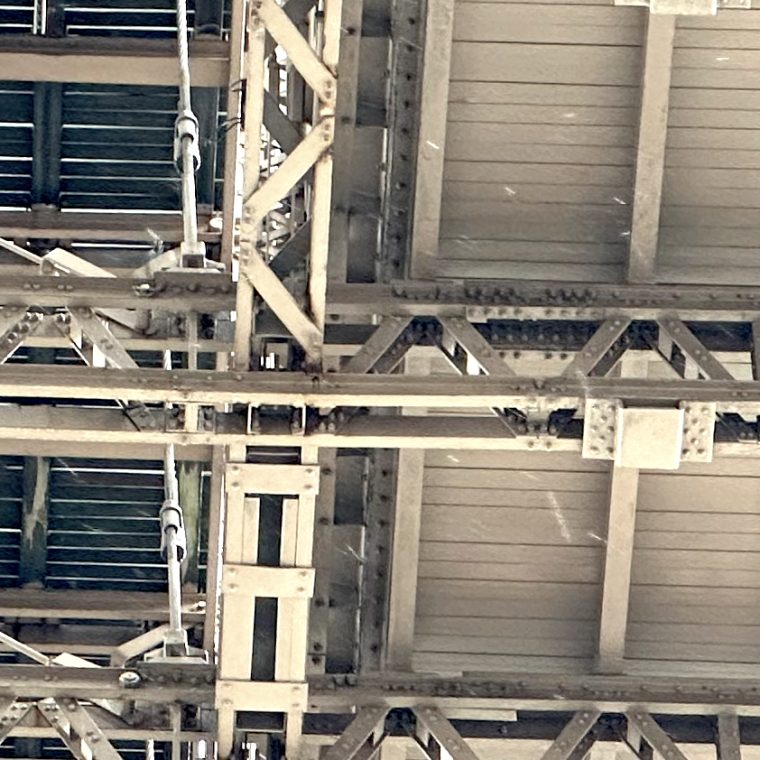

Hardcore bridge geeks will immediately recognize this photo. Everyone else, and hardcore bridge geeks with a sense of modesty, will ask “what is it?”

It’s the underside of the deck of the Brooklyn Bridge, on the side span between the Manhattan tower and anchorage. Starting with the basics, the wide opaque areas on the left and right are the driving lanes, which are just above the bottom chords of the stiffening trusses; and the stripey area in the middle is the pedestrian walkway, which is just below the top chords of the trusses. The striped effect comes from the fact that the walkway is a wood plank. For everyhting else, it’s easier to look at a close-up

We can clearly see the bottom chords of the trusses (red arrows), which are built-up boxes. We can see them so well that we see trusses that dont; exist: there are six bottom chords and only four trusses. The original configuration, before the 1950s reonfiguration that removed the els from the bridge, had six trusses: full-height trusses on eitehr side of the walkway and between the el trakcs (flanking the walkway) and the two outer driving lanes; and half-height trusses at the outer edges of the deck. The two intermediate trusses, which do not align with cables, were removed; the inner trusses, which align with the inner cables, stayed as is; the outer trusses, which align with the outer cables, were made the same depth as the inner trusses by having a new top chord and new web members form that chord down to the old top chord added.
The deck girders (green arrows) are little built-up trusses, spanning between the bottom chrids of the stiffening trusses. In this close up, you can clearly see the gaps bewteen the boards of the walkway, although the light coming from above has exaggerated their width. When you’re walking on the deck, you have to really look to see through the gaps to the water below. You can also see the electric conduit for the bridge lighting and the maintenance catwalk, directly below the pedestrian walkway, to reach the conduit.
The most interesting part of this for me is the deck expansion joint, made visible by the doubled deck girders (blue arrows). This does not have to be there, but is present for two reasons. First, the ability of engineers in the 1870s (when Washington Roebling finalized the deck and truss design) to deal with thermal movement was limited except through the use of expansion joints. Second, it simplified the overall stiffening truss design.
You must be logged in to post a comment.