
Back to my travelogue of the tour of Swiss and German bridges. This is an overall view of the rail viaduct across the Thun River valley at Ossingen, Switzerland.

It was completed in 1874, and is still in use, carrying trains over the valley. Most of the sources I found are very sparse on details or in German, which I don’t read, so here is: the information. From looking at is: it’s a continuous lattice truss on trussed towers. As is true with most lattice trusses of the nineteenth century, the web diagonals are quite small and the chords are large and built-up. A tower, closer:

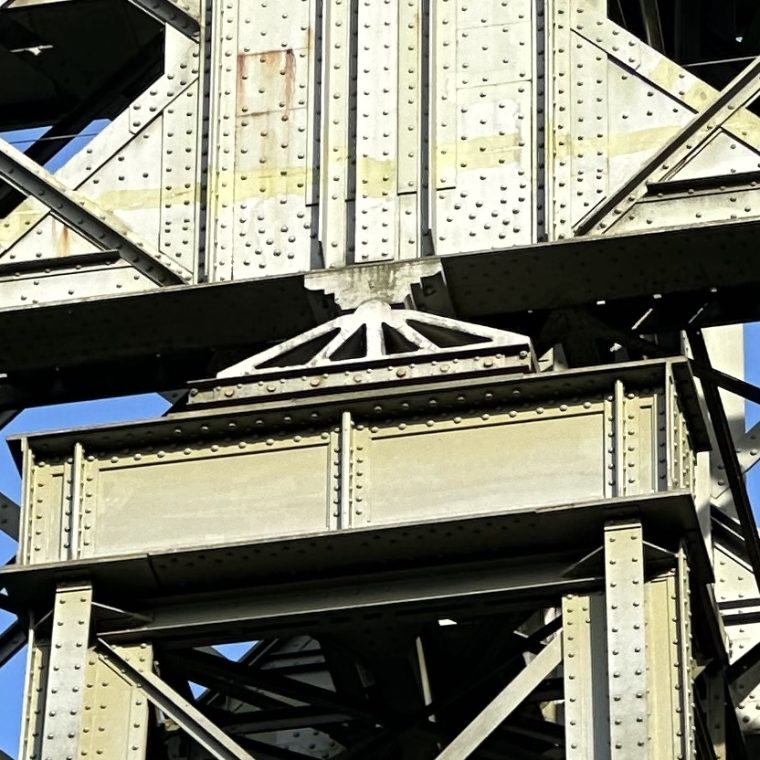
And the beautiful hinged bearing:

There is a narrow footpath next to the tracks, so we walked across. And on top, we saw a detail whose meaning none of the dozen engineers on the tour could completely agree upon. Relatively recently, a small warren truss in the horizontal plane was added on top, between the rails.

It’s too shallow (side to side) to make a significant difference in the overall strength of the deck when subjected to lateral wind load. And it helps even less with overall stiffness. My guess is that it’s there for local strength stiffness: when a group of wheels (a “wheel truck” is the somewhat confusing phrase) is midway between two of the deck beams, there’s not a lot of structure to carry lateral wind loading. By putting this little truss right between the rails, any wind load gets carried locally to the deck beams. (The deck beam locations can be seen by the stiffener plates at the main truss and by the joints in the little truss.) So the little truss isn’t carrying load to the towers, only to the main truss bracing. Here’s a view of the truss-work from below, and you can see that there is horizontal-plane wind bracing at the main panel points, as defined by the deck beams.


You must be logged in to post a comment.