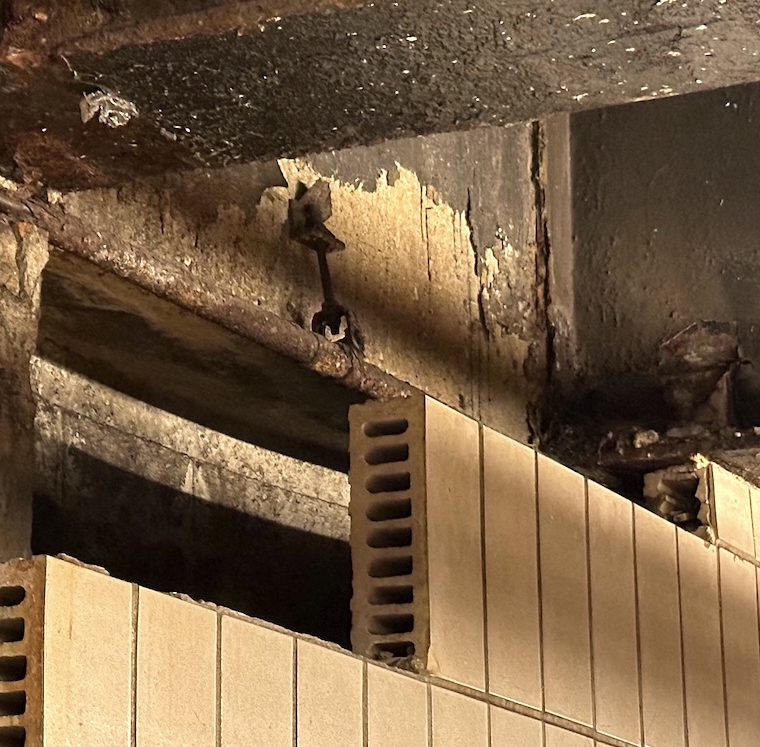

A peek behind the surface at the 68th Street station on the Lexington Avenue (6) train.

This station was part of the Dual Contracts expansion of the subway system, and opened in 1918. I’m pretty sure the platforms were lengthened at some point after that, probably in the 1950s or 60s. In any case, what we see here is a 1960s-vintage curtain wall (or screen wall, or fascia, take your pick of terminology) in front of the actual structural wall of the station. I was at the far back end of the platform, so this may be an extension rather than the original station. The edges of the glazed blocks are very clean, which suggests to me that this was an intentional removal, possibly a probe to investigate the condition of the structural wall hidden behind.
Most of the subway system was built before World War II, which is a way of saying that it was built with a much smaller palette of materials than could be used today. Most of the underground portions are below the water table; all are surrounded by ground water to some degree. The side-wall construction is as important as the (more obviously important) roof construction.
You can always see the roof girders on the right, which are meant to be exposed with the station. If the curtain wall was intact, you would not see the columns they are attached to, nor much of the spandrel beam parallel to and slightly back of the curtain wall face. It’s hard to see in this photo, but the concrete structural wall has a scalloped interior face, because it’s configured as barrel vaulting spanning column to column. The wall has to resist considerable inward pressure from both earth and water, and vaulting is arguably a better very-long-term solution. The rust here is minor (but not zero, and if there was a known leak, that would add to the inspection-probe suspicion) and may be the result of a leak through the roof, rather than the wall.

You must be logged in to post a comment.