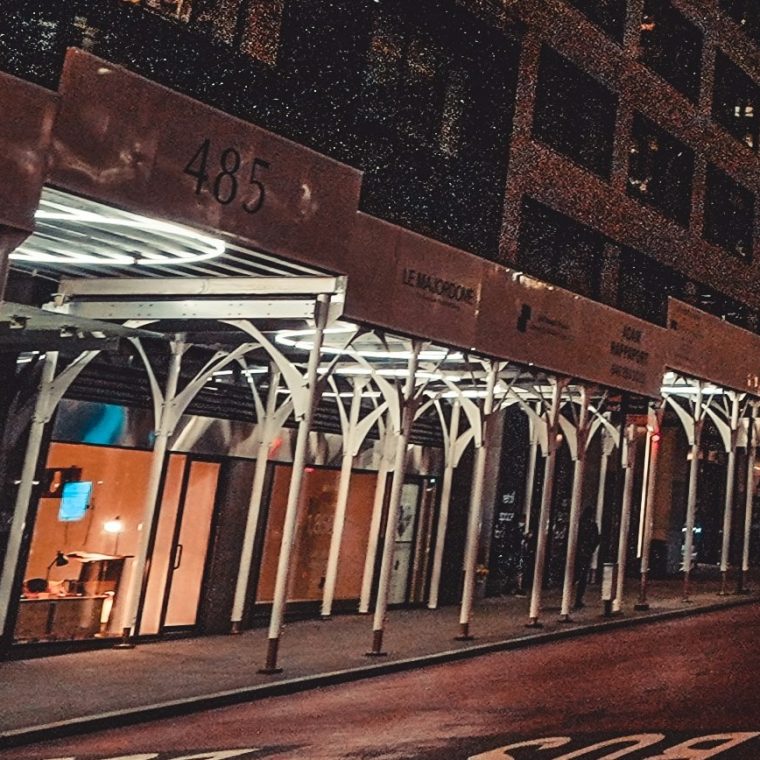

For people who don’t work on facades in New York, “Here’s why NYC sidewalks are (still) covered with 400 miles of scaffolding” by David Brand is worth a look. It’s a good introduction to the tangled issues around sidewalk sheds.

A very short summary: the response, for decades, to learning that there is a problem with a facade has been to put up a sidewalk shed. Some building owners can’t afford the necessary repairs, and some delay repairs for other reasons; the presence of the sidewalk shed blunts the urgency because it addresses the immediate concern of falling material. Sheds can stay up for years and a few infamous cases have remained in place for a decade or more.
Since I just recommended the article, I’m not going to recap it all, but I want to add a few thoughts about this issue. First, safety precautions are a pain until you experience life without them. People have died in New York from being hit by falling masonry – the entire facade inspection program was triggered by one such death. Removing sheds from the streets is a worthy goal, but safety has to come first.
Second, alternatives to sheds, such as netting, can work in some cases but not all. And the reasons why that is true, which are related to the way in which the walls of the specific buildings in question are put together, can be quite opaque to building owners.
Third, the conditions are in some ways getting worse. When I started work, in the late 1980s, most of the steel-frame “pre-war” apartment buildings were more or less 50 to 70 years old. They’re now more or less 85 to 105 years old, and relatively even more valuable today then they were 40 years ago. Given that unrepaired damage tends to not just get worse, but it gets worse at an accelerating rate, every additional year increases the problem for buildings that have not been properly maintained.
Last, and this is a point I’ve tried to make to building owners for some time, with differing degrees of success, people have to accept that they will be spending money on a regular basis for maintenance. To put it another way, the simple fact that a building exists, and is sitting out in the weather, means that its exterior is gradually deteriorating. Depending on the facade materials, the level of ornament present, and the age of the building, the rate of that deterioration can vary widely, but it’s never zero. You can spend a little money every year, a larger amount every five years after a facade inspection, or a lot of money every twenty years when something fails. And it must be noted that because the damage gets worse at an accelerating rate, the cost of repairs every five years is more than five times the cost of working every year* and the cost of working every twenty years is much more than twenty times the cost of working every year.
* The cost of access – standing scaffold, swing stages, or lift trucks, blurs this math a bit, but it’s still true for most buildings.

You must be logged in to post a comment.