

I’ve talked about some of the weirdness of Park Avenue before, but there’s a basic problem with the street’s name: there’s no park. There are planted medians, but they’re not accessible to foot traffic and narrow enough that even if you could get out onto them, you’d be unpleasantly close to traffic on each side. But for a while that wasn’t true.
The typical Manhattan “Avenue” is 100 feet wide, lot line to lot line, which leaves a lot of room for traffic even with 15-foot wide sidewalks. Park Avenue is 140 feet wide because of the presence of the approach tracks heading south to Grand Central. The tunnel itself is not that wide, and when the tunnel widens for the station approach, the tracks are under the neighboring buildings. The tracks used to be partly at grade and partly in an open (and partly-roofed) cut, so making the street wider was a way to reduce the effect on traffic. When the New York Central electrified all the trackage within the city and built the new Grand Central Terminal, starting shortly after 1900, the tracks were put in a fully-enclosed tunnel. The air-rights over the approach and the lots adjacent to the avenue suddenly became much more valuable and were redeveloped with high-end apartment houses. And the extra width of the street was used, in midtown, for a wide park-like median, reminiscent of something like Eastern Parkway in Brooklyn:

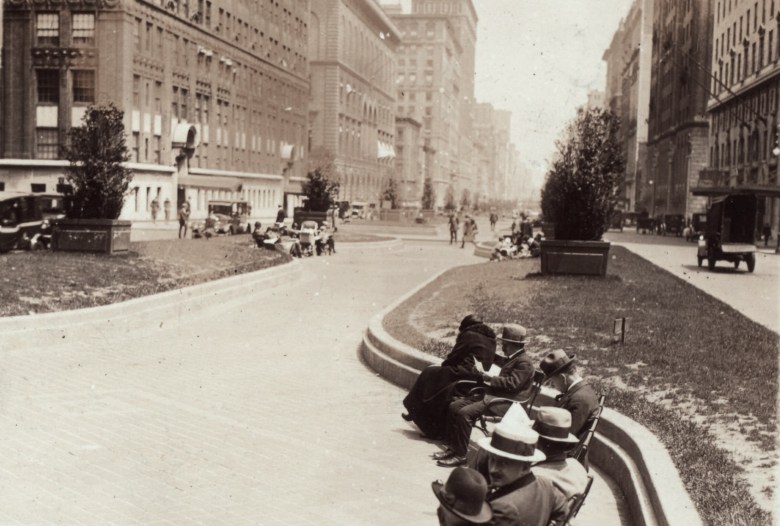
It didn’t last long. The wide median was built in the early 1910s and was narrowed to its current width by the late 20s:

Here’s roughly that same area, with the wavy perimeter on the median park, shown on a 1930 Sanborn map, after it had already been removed:

In any case, roughly a century later, the city has committed to widening the medians by 20 feet, which will put them back near the original width.
Good.


You must be logged in to post a comment.