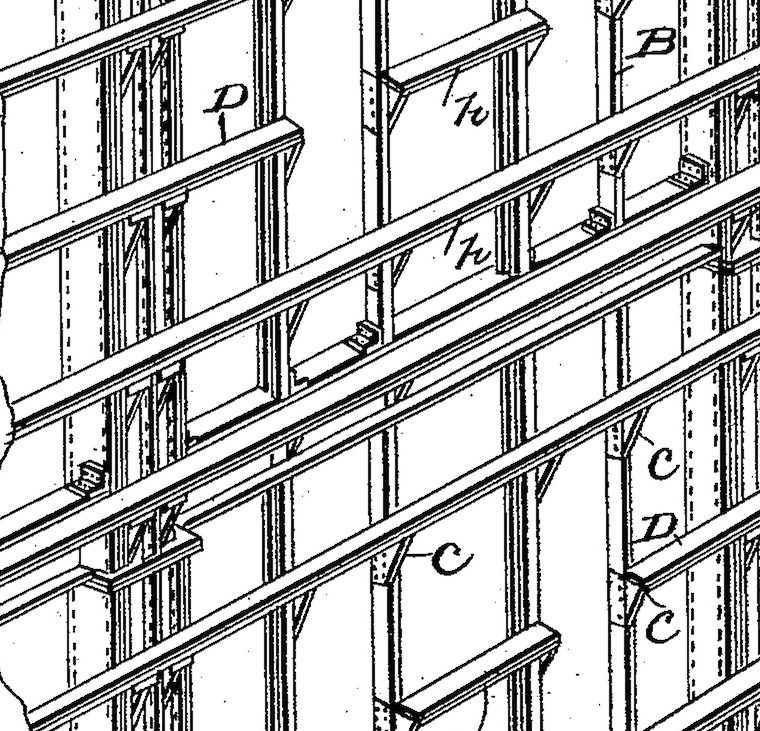

The first two parts of this series looked at patents that involved odd details that were not really part of the metal-frame revolution that was taking place in the 1890s but rather adjacent to it. Neither of those patents reflected actual structure that I’ve ever seen in an old building. Today’s example is a bit different: patent 542203, awarded to John Pelton, Jr., on July 2, 1895 from a November 14, 1892 application, is about a real piece of a skeleton-frame building. I have not seen structure exactly according to this patent either, but I’ve certainly seen similar ideas in use.

The columns look like what we’d expect for a skeleton-frame building, and the spandrel beams are more or less what what we’d expect. The striking thing about this drawing is the presence of shelf angles for almost every separate course of (relatively-thin) veneer masonry, supported on structural-steel studs that run spandrel beam to spandrel beam. Pelton’s description – again, written in 1892, when the oldest skeleton-frame high-rises were two years old – is fascinating: “My invention relates to that modern construction of buildings in which a steel or iron frame is inclosed in a brick or other wall or casing, so as to form a composite structure having great strength, by reason of which it can be carried up to great heights. In this class of buildings the element of strength is contained in the steel or iron frame, while the outer wall or casing merely furnishes an inclosure and provides facilities for an architectural design and ornamentation. The object of my invention is to provide an inclosure for such buildings that will materially reduce the thickness of the walls, and at the same time be equally as serviceable and substantial as walls of greater thickness, while the expense of construction will be measurably reduced.” That’s a great statement about the idea behind skeleton framing and the logical next step for designers to take: once you’ve removed the structural function from the exterior walls, leaving only enclosure, do you really need or want the huge mass of undifferentiated masonry that made up the walls of that era?
Pelton has pointed the way to the future: he’s providing secondary steel for the local structural action of transferring gravity and wind loads from each piece of masonry to the building frame. No one was ever very interested in that kind of secondary framing within the masonry walls of an ordinary building – simple shelf angles like his piece “h” at the floor levels eventually took over from the crude early method of sitting the back half of the masonry wall on the spandrel beam and letting header bricks cantilever out to the veneer. But his drawing bears a resemblance to some of the first generation of stick-built glass-and-metal-panel curtain walls from the 1950s. I originally wrote that as “a remarkable resemblance” but if you follow the logic of separating structural function from enclosure, this is one of the inevitable designs. Congrats to Mr. Pelton for seeing it so early, even if no one was listening at the time.
You must be logged in to post a comment.