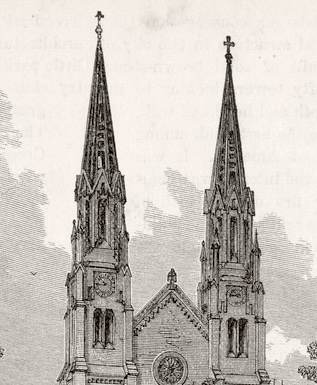

From the New York Public Library scrapbooks, two pictures of St. George’s Episcopal Church at the corner of 16th Street and Rutherford Place, on the west side of Stuyvesant Square:


Something seems different…can’t quite put my finger on it…
The spires were removed in 1889, 33 years after the church was first completed and 22 years after it was rebuilt following a fire. That usually means they were unsafe, and the key detail is in the designation report from the Landmarks Preservation Commission: “Originally, beautiful spires, displaying handsome open stone work, adorned the church, but they were declared unsafe in 1888 and removed the following year.” You can just barely see the “open stone work” in the first picture. I do not find it very surprising that a framework of brownstone ashlar either deteriorated enough from freeze-thaw cycles, or broke enough from wind pressure, or both, that it became unsafe in thirty years.
My personal experience with open-work spires was at the Fifth Avenue Presbyterian Church, another big brownstone-faced building, completed in 1875. The south spire is fairly ordinary solid stone. The current north spire was erected in 1990 – I was the structural designer – and consists of a copper skin, in an open design, over a stainless-steel frame.

Before that there had been nothing on top of the north tower since, I believe, the 1920s, when the previous north spire, an open frame of cast iron, was removed because it was unsafe.

The iron had apparently broken from wind-induced movement. The reason for the open north spire is prosaic and probably unrelated to anything at St. George’s: the north spire at Fifth Avenue was directly over the original boiler flue, and was, as far as I can tell, a way of hiding that function.
You must be logged in to post a comment.