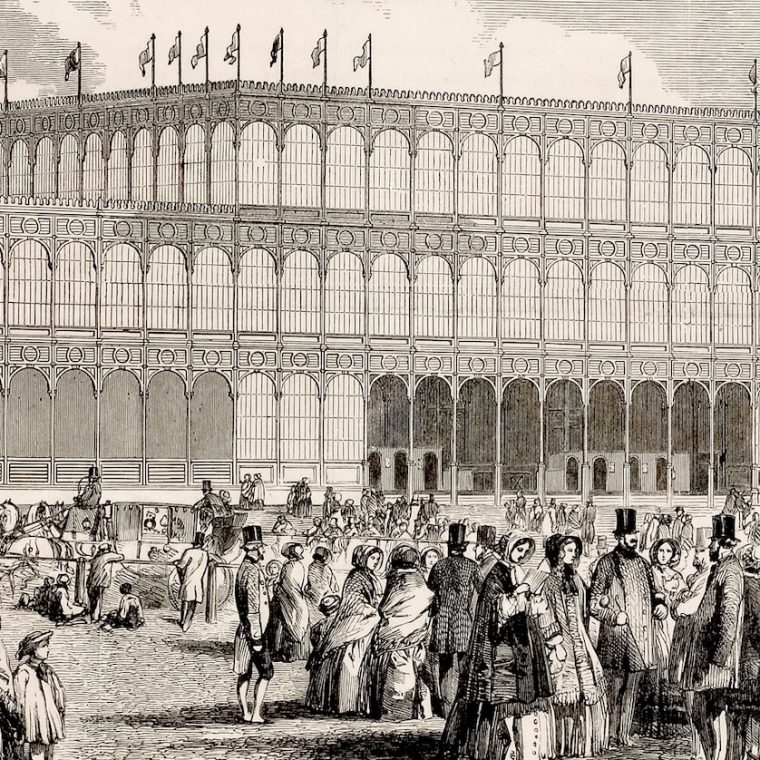

In “How London’s Crystal Palace was built so quickly”, Jennifer Ouellette gives a good summary of a recent paper “Thread form at the Crystal Palace” by John Gardner and Ken Kiss. My even shorter summary: the 1851 Crystal Palace in London was made possible, in part, through the use of standardized bolts and nuts. Such standardization was a hot topic throughout the nineteenth century until being generally accepted with the creation of multiple standardization agencies world-wide after 1900. (There is, obviously, a certain irony in there being multiple organizations charged with creating standards in the same fields, but they were organized on a national basis, and so there was little hope for unified standards until after World War II.)
The British standard for bolt threads proposed in 1841 and eventually adopted in 1905 was apparently used at the Crystal Palace for the 30,000 bolts in the main frame. If the use of standard – i.e., identical – threads saved one minute per bolt by eliminating filing metal to fit, or searching for the nut that fit a particular bolt, that was 500 laborer-hours saved, which is not nothing. The history of metal manufacturing suggests it may well have been several minutes per bolt.
This idea of standardizing machined parts used to be commonly referred to as the “American system of manufacturing” because of the insistence of the US army in the 1820s that all guns have interchangeable parts for easy assembly and repair, which only works if the parts are identical. That name conveniently ignores the earlier contributions by Marc Brunel to manufacturing pulleys for the British Navy. It also ignores the full story of a famous demonstration by Eli Whitney in 1801, where the gun maker showed a group of muskets to the Secretary of War, disassembled them, and then reassembled them after swapping parts, a feat that should only be possible if the parts were identical and interchangeable. Whitney apparently cheated by carefully selecting the guns that were the closest to identical from among the variable-quality output of his factory.
Like many “revolutions” in technology, the path to standardization was long (in this case, about a century) and only seems obvious after the fact. That makes it no less important, and the news about the Crustal Palace is another piece of the mosaic picture.
A good view of the exterior of the Crystal Palace:

And a lousy view of the interior, sort of showing some of the connections between trussed griders and columns:


You must be logged in to post a comment.