
A piece of a single sentence in the 1893 Baedeker description of New York sent me down a rabbit hole. In a proper library I believe that I’d find a hard answer but playing around on the internet from hime, I’m left with a partial guess. The phrase, under the heading of Theaters is: “Metropolitan Opera House, Broadway (burned in 1892).” The Met burned? Huh?
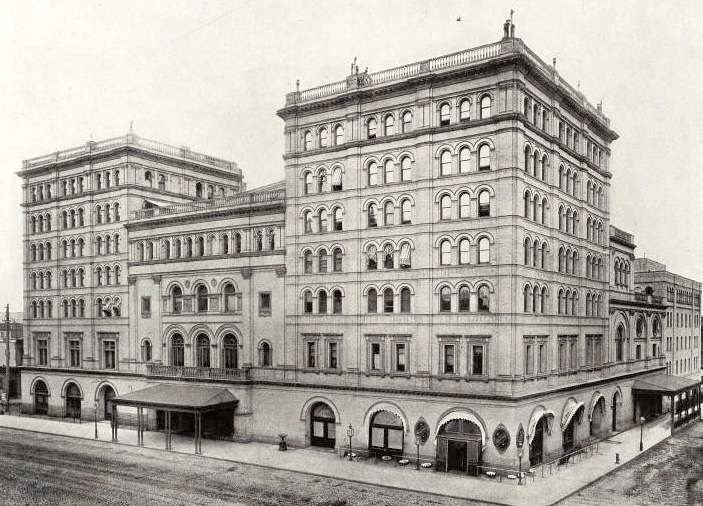
The Metropolitan Opera began in 1883 as a new-money rebellion against the exclusivity of the old-money Academy if Music, and as far as I knew, the building constructed then was the same one demolished in 1967 when the opera company moved to Lincoln Center. The outside of the old Met was nothing very special, the auditorium was nice, but the backstage are was too small to store all the scenery needed for the grand productions staged. Here it is in 1905, with the New York Times Building on the right:

It’s hard to find precisely-dated images of individual buildings. Here’s 1884, but it’s very low resolution:

Note the many-armed telegraph/telephone/electric-power pole in the distance, just to the left of the far corner of the building. The vast majority of those poles were removed after after the Blizzard of 1888, which tore down the wires and convinced both the city government and the utilities that rebuilding underground made more sense than restoring the widely-hated elevated-wire network.
Here’s a view unhelpfully dated as 1860 to 1900:

The European and American Views company was not a big player in the stereoscopic postcard business. One source I found described their work as “poor quality pirate views” and gave dates of 1870s and 80s. That pole is in the picture, which is far from conclusive proof that this was before 1888 or only a few years after, but I’ll take that leap. The presence of the horse car is not conclusive: the Broadway line at 39th Street wasn’t electrified until 1901, and the cable-powered portion of it ended at 36th street.
Finally, here’s a view proudly described as 1914, but that’s wrong:

It comes from a book put out by the Marc Eidlitz & Son construction company, published in 1914 but showing their work from many previous decades. The low height of everything around the opera house is proof that this was an earlier photo. Note the pole off the left corner.
So…judging by the low-res 1884 photo, the high-res but undated E-and-A photo, and the 1905 photo, the exterior of the building didn’t change post fire. The building was of fireproof construction, which is the only reason it wasn’t replaced long before the 1960s. Based on the August 28, 1892 New York Times description of the fire, the fire destroyed the scenery and equipment (such as hemp-rope rigging) of the stage area, and the seats and other interior finishes of the auditorium. The only damage to permanent building structure mentioned is the collapse of a large skylight over the stage.
You must be logged in to post a comment.