
From the Detroit Publishing Company, the Thirty-Fourth Street National Bank “between 1900 and 1910”:

If that name seems a little odd, it’s important to remember that most banks used to be local, with one location, and even the biggest banks had a handful of branches at the most. A list I found of banks had 16 pages of listings in New York State, most with very local-sounding names. The Thirty-Fourth Street bank as an institution was founded in 1902, but I’m interested in that building.
Thirty-fourth Street is roughly 2 miles long, East River to Hudson River, but I didn’t need to check all of that. West of Eighth Avenue and east of Third Avenue back then were areas of low-cost residential and industrial buildings, and look closely at that picture. Those are some large and high-end rowhouses on the right and a quite fancy building in the distance, past the construction site.
So, it’s a simple brute-force search of the 1910 Sanborn maps, looking for a bank that’s one lot (25 feet) wide. This isn’t it (ignoring the bank name, because those can change or be mislabeled), even though the rowhouse could be correct, because the bank is two lots wide:

(Note all of the maps have been rotated to put north at the top.)
This looks much better:

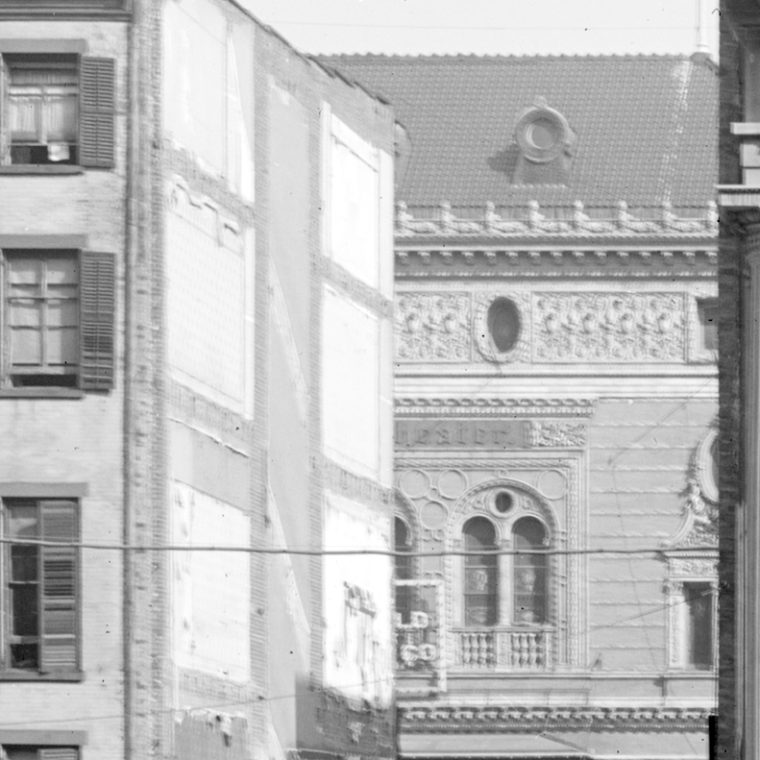
The bank is the right width, and there’s a big building to the left of the bank that could have been the construction site in the photo. But the proof is a block away, on 35th Street: the Garrick Theater is correctly located to be the ornate building in the distance in the photo. Here’s the front facade of the Garrick (under it’s original name):

The second-floor arched windows match exactly.
The Monolith Building, as its name suggests, was one of the earliest all-reinforced-concrete buildings in New York. It’s still there, as is the adjoining Marbridge Building. Monolith was built in 1906-1907, so we’ve narrowed the time-frame for the photo down to a year or so.
The fact that the bank is the same height – 62 feet – as the two adjoining rowhouses makes me suspicious. Looking at the front facade, it looks like the 2nd, 3rd, and 4th floors of the bank align with the 2nd, 3rd, and 4th floors of the house to the right. If, for the sake of argument, the bank had been another house in that row, and its facade was replaced and the parlor floor lowered to street level to eliminate the stoop and create a high first floor, this is exactly what it would look like. Here’s an 1899 map of the same area (which also shows how fast redevelopment from residential to commercial use was taking place), and look: 41 West 34th Street is identical to the houses east and west of it.

That’s not proof, of course, but in my opinion it would be remarkable for a smallish local bank to have built an entirely new headquarters building in its first decade rather than taking the easy route of repurposing a rowhouse.


You must be logged in to post a comment.