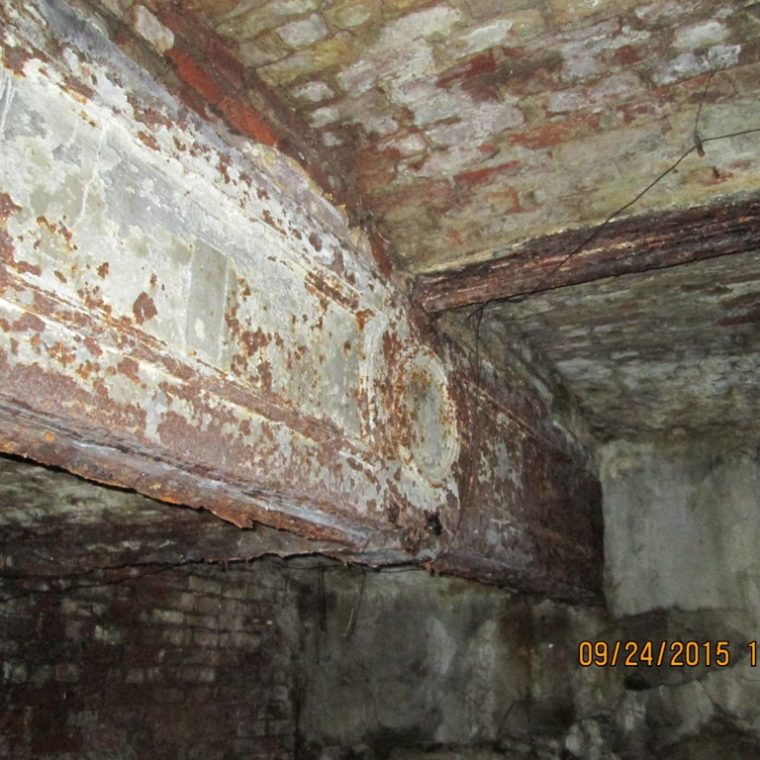

From September 2015, I guess, a photo of some badly weathered structure supporting the roof of a sidewalk vault. In other words, all of those rusted beams are what is holding up the brick vaults that the sidewalk sits on.

The brick vaults are supported on the bottom flanges of wrought-iron I-beams; those beams are supported on a big cast-iron girder. Here’s a copy of the photos with some doodling to make my discussion clearer:

The green line marks the bottom side of the bottom flange of an I-beam that is otherwise buried in the brick vaulting. The blue marks are on the cast-iron girder, which is the thing I really wanted to talk about.
First, note that the cast iron is in better condition than the wrought iron. Wrought iron rusts the way steel does: the surface rusts and, in the process, separates (delaminates) from the metal below. The delamination exposes a new surface of metal, previously hidden within the body of the metal, that now beings to rust. That’s why – as we frequently explain to clients – rust jacking takes place. The delaminated rust occupies a bigger volume of space than the intact metal did. Cast iron, on the other hands, rusts more like aluminum does: the rust product stays bonded to the metal below and, in doing so, provides some protection to the metal below against rusting. Given enough time, cast iron will rust through, but it is a much slower process than wrought iron or steel.
On the other hand, cast iron fails brittlely and is relatively weak in tension, so it’s a terrible choice for beams in general and specifically for beams with high live-load-to-dead-load ratios like those supporting a sidewalk vault roof. If this roof were loaded to code levels – picture a truck parking on the sidewalk – there is a good possibility that girder would simply snap, collapsing the sidewalk. This has happened more than once with similar vault structures. In short, under ordinary circumstances, the sidewalk is loaded with people and maybe some boxes piled up. And it performs fine. But there’s no way to accurately predict when it will fail if loaded the way the building code says it might be. That girder will look good up until the moment it fails catastrophically, which is why we no longer use cast-iron beams.
Meanwhile, my blue doodles? That’s ornament cast into the beam, because cast iron molds were so easy to add ornament to. There are moldings near the top and the bottom which lead periodically to circles of molding – the one I highlighted and the one at the far left of the picture.

You must be logged in to post a comment.