
Around 1800, State Street was a fine place to live if you were wealthy. Battery Park was considerably smaller then, as a lot of landfill had yet to take place, and the harbor fortification called West Battery (later Fort Clinton and, after it was decommissioned as a fort, Castle Clinton and Castle Garden) would be built 1808-1811 not far away on a large rock just off the tip of Manhattan, but State Street had a great view of the harbor while being insulated from the working docks further up the East River.
Here’s a somewhat fanciful but not terrible 1913 newspaper print of an 1850 engraving:

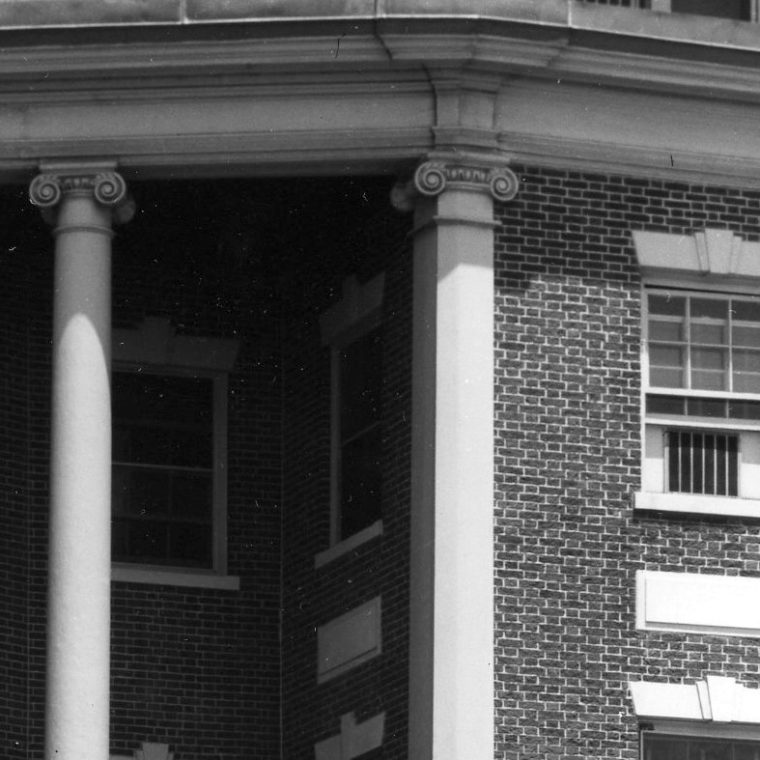
Note the house at the curve in the street on the right, with the colonnaded porch. That’s 7 State Street. The plainer right half was built in 1793; the left half with the colonnade was added in 1806. The design is “attributed to John McComb, Jr.” Given that McComb was pre-eminent among the very small number of architects in New York at that time, this is not a huge leap.
State Street eventually lost its social status as the wealthy moved uptown, and the house became a church property. Here it is in the early twentieth century:

Unlike its neighbors to the right, the exterior was still mostly intact, if showing its age. It was restored shortly before its landmarking in 1965, and here’s one of the LPC photos showing how well the work was done:

It’s now part of the Shrine of Elizabeth Seton, and the building on the left in the 1965 photo has been replaced by the sanctuary building of the shrine. The tall masonry building on the right has been replaced by a 1970s skyscraper.
I’ve talked about this issue before: it’s great that the building has survived well into its third century, but literally all context has been lost. All the original neighboring buildings are gone, State Street is a wide major road with heavy bus traffic (at least the elevated train that showed up in the late 1800s is gone), and Battery Park is quite different. Half a century ago, Robert Caro, in The Power Broker, described 7 State Street as “an ironic grace note in a cityscape without grace.” Most people don’t have the ability to imagine the streetscape the house belonged in without help, which is why museums have various forms of representation to recreate the past, but there are none here.
I got most of the information about the history of the house from the NYC landmarks Preservation Commission designation report, from November 1965. The reports are numbered consecutively since the creation of the LPC, and this is report 36, which in my opinion is a recognition of the relative importance of the house to the preservation community.

You must be logged in to post a comment.