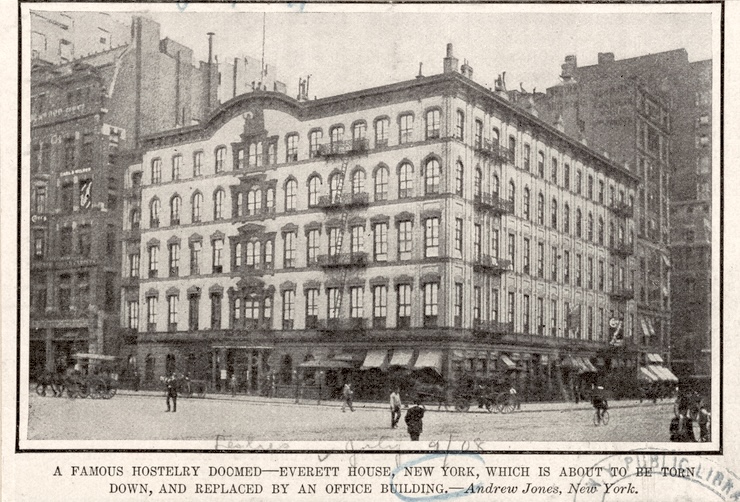

I mentioned the Everett House, a hotel on the corner of 17th Street and Fourth Avenue once before, briefly. Here it is before demolition:

I can’t read the name of the publication – the first word written in pencil – but the date is July 9, 1908. The high-rise loft building that replaced it was completed in 1909, so demolition can’t have started very long after this picture.
The hotel opened in 1853, when Union Square was a residential neighborhood of rowhouses: in its existence, it went from being one of the taller and larger buildings in the immediate area to one of the smaller ones. The exterior looks pretty much the same in every photo I’ve seen of it. Unlike some other hotels, it did not grow vertically or horizontally. Its clientele changed, however, from high end tourism and leisure to middling business stays.
More than anything else it was killed by social change: Union Square was simply not the best place to be running a hotel in the twentieth century, especially compared to fifty years earlier. But its slide down the social scale was also the product of physical characteristics of the building. When it opened, the good supply of water from the Croton reservoir system was barely ten years old. I’d assume that the hotel as built had a handful of toilets and baths per floor, maybe with sinks in each suite. (Or possibly chamber pots rather than toilets, given concerns about sewer gas in those days before the use of the plumbing trap.) Heating came from burning coal in fireplaces, lighting was likely some combination of gas-lighting and oil lamps.
Expectations changed with new technology. The New Tenement Law in 1901 mandated a toilet for every apartment, for example. The Everett had some modern plumbing installed, steam heat, and even electric lighting. But that kind of retrofitting was always awkward using the technology of the era.
The other problem is that the hotel, like pretty much every New York building of its era, was flammable. Here’s the 1903 Sanborn map for the block:

Pink indicates flammable buildings. The straight lines indicate internal masonry walls that served as partial firewalls, but most of the building lacked that kind of compartmentalization. This was not a theoretical concern: in 1899, the physically-similar Windsor Hotel had burned down in a spectacular and deadly manner. I suspect there’s a direct causal link between that fire, which led to an investigation of hotel safety, and the details of fire-fighting equipment and watchmen noted.
If the neighborhood had not changed, it might have been worth all the physical alterations necessary to bring the Everett House up to modern standards. As it was, no one cared enough to spend so much money on improving a building that was on its way out.

You must be logged in to post a comment.