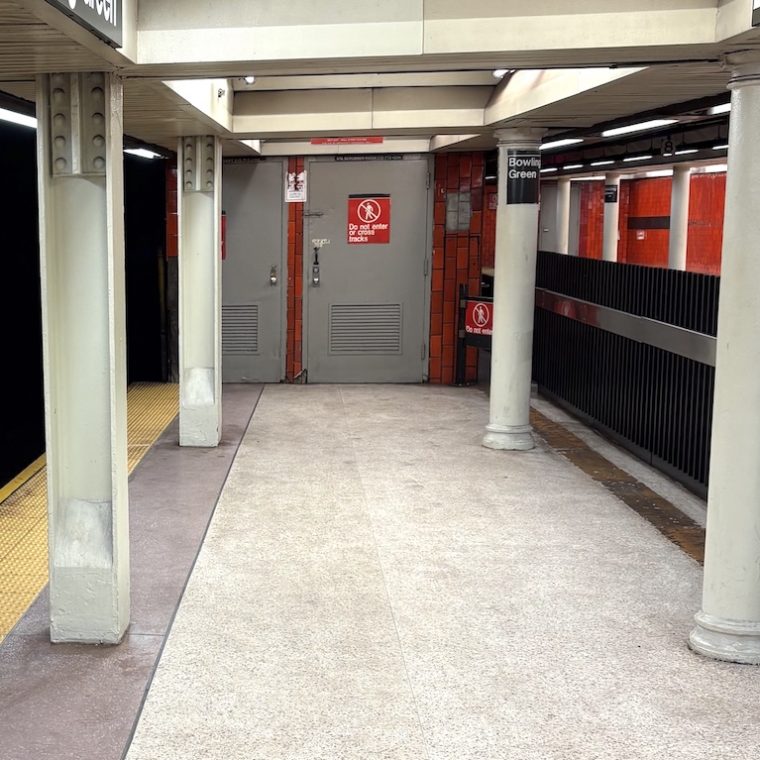

The north end of the Brooklyn-bound platform on the Lexington Avenue (4 and 5) trains, at the Bowling Green Station, yesterday:

This is the southernmost station on the line in Manhattan, and trains headed south from here almost immediately turn east and enter the Joralemon Street tunnel, heading for Brooklyn. The original 1904 IRT subway included what’s now the Lexington Avenue line from Brooklyn Bridge to 42nd Street, as well as the now-abandoned City Hall loop and station. The extension down Park Row and Broadway from the Brooklyn Bridge staton took place in stages: to Fulton Street and then Wall Street in separate campaigns in 1905, an extension to Bowling Green and South Ferry in 1905, and then the separate exit from Bowling Green to the tunnel and Brooklyn in 1908. So this station opened in 1905 and was reconfigured a but in 1908. It was reconfigured a great deal in the 1970s, along with the abandonment of the two-stop shuttle from Bowling Green to South Ferry. Even if the history of use wasn’t readily available, the combination of purple terrazzo and orange glazed brick is enough to mark the last renovation as the 1970s, a taste-free decade. But none of that is what I wanted to talk about…
This is an island platform, with tracks on each side. Originally it served the north- and south-bound trains; when the side platform for northbound trains was built in the 70s (you can see a bit of it on the right), the fence on the right was built and the island converted to serving only southbound trains. The tracks in the system are spaced closely in the tunnels, typically with just enough room for a row of roof-support columns between each pair, so island platforms require the tracks curve out to make room. (Side platforms, used at most local stations, do not require that curve, as only the outer two tracks get platforms.) So island platforms typically have a lens shape in plan: widest in the middle and narrow on the ends.
In this case, we have round cast-iron columns on the right side of the platform all the way to the end, and on the left side almost to the end, with the last two columns being steel wide-flanges. Since wide-flanges that size were not in use in the US in 1908, that’s part of an alteration, probably the 70s work. Why? The length of trains in the system was increased several times after 1904, finally ending at ten cars. So the stations had to get longer, expanding into what had previously been tunnel, and the platforms had to get longer. That’s easy with side platforms, but rather annoying with island platforms, as the track curves had to be moved. If you picture the platform width tapering down to just a few feet, bounded by tracks on each side, and now you move the tracks so that the platform can be extended, you’re adding a sliver of new platform on one or both sides of the existing, and probably changing the tunnel column layout to avoid conflicts with the new track layout. What does that look like in practice? A couple of new columns being added in the new part of the platform, to carry the roof beams to the now-moved-outward side wall.
Finally, why cast-iron versus steel? Cast-iron columns were already on their way out when the serious engineering for the IRT started around 1900. The HAER report on the original IRT – 614 pages long – quotes William Barclay Parsons, the chief engineer for the IRT, as saying that cast iron was used at the stations, rather than steel as in the tunnels for “a better architectural effect.” That quote comes from “The New York Rapid-Transit Subway”, a 1908 article in the UK Proceedings of the Institution of Civil Engineers. The full quote is “As a general rule, these platform-columns are of cast iron, which gives a better architectural effect and, being round, they occupy less space.” Whether or not round columns are more architecturally pleasing than built-up H shapes is a matter of taste, although in the early 1900s taste definitely ran the way Parsons suggests, but the steel columns would not have needed to be bigger than the iron. Maybe Parsons – a giant in civil engineering history, so someone I’m always going to give the benefit of the doubt to – meant that the lack of corners make the round columns less intrusive on the usable space.


You must be logged in to post a comment.