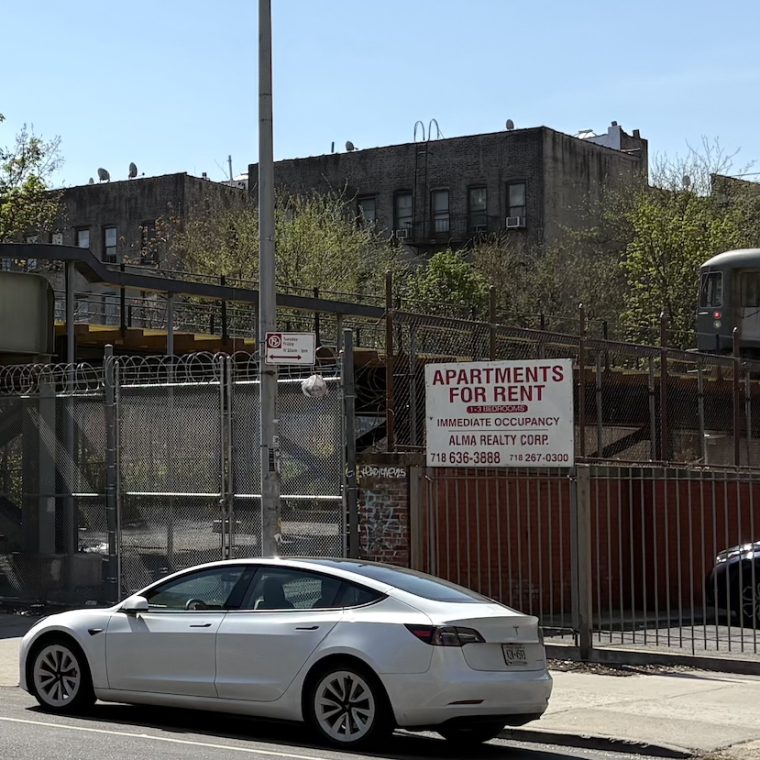

Behold the glory that is the Franklin Avenue Shuttle:

In addition to its not-very-New-York-like construction as an elevated, skulking through rear yards rather than running over streets, it has only one track for most of its length and runs two-car trains (the NYC subway standard is ten cars per train). It has four stops – a fifth was closed about thirty years ago for lack of ridership. The main reason it survives is that allows an easy all-rail transfer between the Fulton Avenue subway (A and C trains) at Franklin Avenue, the Brooklyn branch of the IRT (2, 3, and 4 trains) at Franklin Avenue/Botanic Garden, and the Brighton line (B and Q trains) at Prospect Park.
It has a longer history than you might expect: it opened as part of the Brooklyn, Flatbush, and Coney Island Railway in 1878, allowing passengers on the Brooklyn branch of the Long Island Railroad (then the main line) to transfer and go to Brighton Beach. It was a surface-running steam-locomotive railroad, not mass transit. To put that in perspective, regular service on the Ninth Avenue elevated, the first real1 mass transit in New York, began in 1870. There were multiple railroads competing for the New York and Brooklyn beach-goer traffic, and for whatever reason the LIRR pitched the BF&CI overboard in 1883, leaving it without a direct upstream connection to its desired market. This problem was solved in 1896 by allowing trains from the Fulton Street elevated to run over the tracks. After the usual series of corporate mergers and renaming that confuse any discussion of rail history in the US, all of the elevated trains and most of the subways in Brooklyn were controlled by the Brooklyn Rapid Transit company, and whatever old heavy-rail track of the BF&CI that still remained was rebuilt in its current form.
When the portion of the Brighton line north of Prospect Park was connected to Manhattan via the Manhattan Bridge and Flatbush Avenue tunnel in 1920, the connection between the Fulton Avenue el was ended, and trains ran from the north end of the Franklin line and then over the Brighton line, providing a direct link between central Brooklyn and the beach. That ended in 1963, turning the Franklin line into the shuttle it now is. The Fulton elevated was also replaced by a subway in the 1930s.
There’s no way to discuss this without mentioning the worst accident in NYC subway history, the Malbone Street wreck of 1918. Consider this a trigger warning if you’re reading further. Don’t look for Malbone Street on a map: the wreck was so bad that the street was renamed Empire Boulevard to get rid of the connotation, and it also more or less ended the Brooklyn Rapid Transit’s existence, as it was reorganized as a new company a few years later. The deaths of more than 90 people were caused by excessive speed on an excessively curved track, in a tunnel for the Franklin line crossing the corner of Prospect Park just north of the Prospect Park station; the use of wood cars, as had been common on the elevated lines, contributed to the high rate of injuries and deaths. The accident was unsurprisingly the beginning of the end for non-steel cars in the subways system. Did this accident play a role in ending the Fulton Avenue to Franklin Avenue elevated connections? Maybe: the BRT and its successor the BMT had the option of running trains from Manhattan in the Flatbush Avenue tunnel newly connected to the Brighton line and may have decided to minimize the number of people riding past the accident site.
- I.e., not horse-drawn. ↩︎

You must be logged in to post a comment.