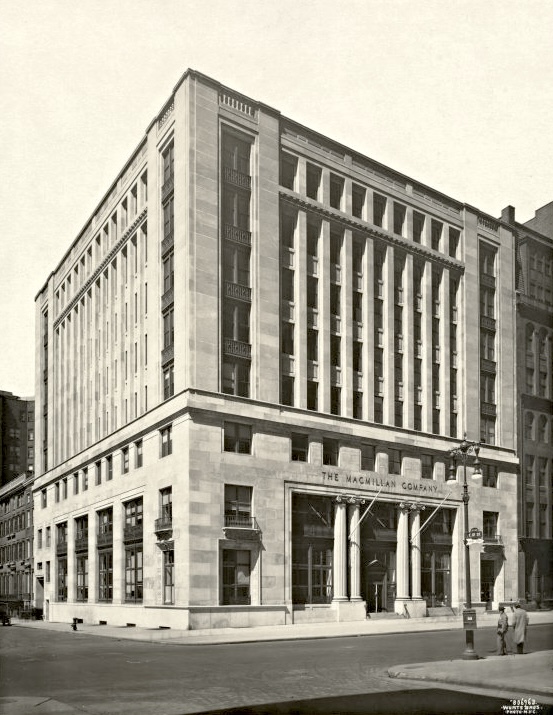

Maybe I’m kidding myself., but I feel like this is a good example of a building that shows you exactly who worked on it:

That’s 60 Fifth Avenue, at the corner of West 12th Street. It was completed in 1924 as the New York (and US) branch headquarters of the UK-based Macmillan Publishing Company. Macmillan was wildly successful in the US and outgrew the building, selling it to Forbes, Inc. in 1962; Forbes went on to sell it to NYU in 2010. The somewhat-classical style and mid-rise height were meant to blend in with the low-rise Greenwich Village neighbors – high-rise apartments weren’t built in the Village until after World War II, even on lower Fifth Avenue – but the style is a bit odd.
The building is just about a cube with only small projecting-ornament elements. Notably, there is no cornice, which similar buildings of the 1900s and 1910s typically had. The center of the fourth- through eighth-floor facades are reminiscent of Louis Sullivan’s Guaranty and Wainwright buildings and don’t much relate to the Ionic columns at the entrance. There are two styles fighting it out here…and then you look to see who the architects were.
The building was designed by “Carrere & Hastings; Shreve & Lamb”. If that compound name seems a bit odd, it is. Carrere & Hastings was a firm specializing in Beaux Arts design, founded in 1885, and best known for the main building of the New York Public Library. Shreve & Lamb is better known by its post-1929 name, Shreve, Lamb & Harmon, and as the designers of the Empire State Building. It appears that the older partners at C&H, recognizing that S&L were interested in branching out into modern architecture, had them as a subsidiary firm for a few years, before S&L left in 1924. In any case, look at the upper floors and compare to the later work of S&L and SL&H; look at the first and second floors and compare to the earlier work of C&H.

You must be logged in to post a comment.