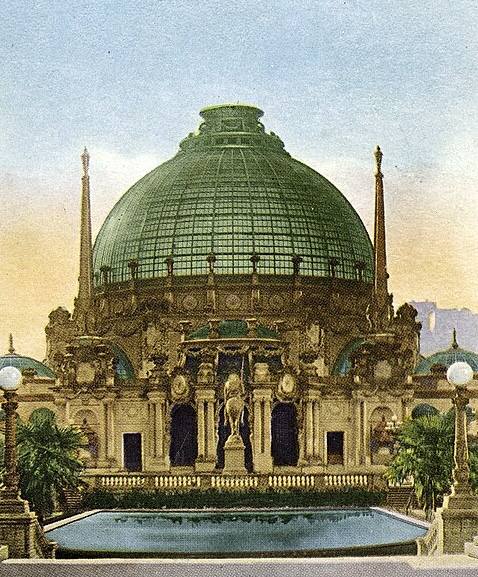

A random reference I came across while reading a few days ago led me to this blog post, which I can pretty much guaranty will be the strangest I’ve ever written.1 It’s a fake-history conspiracy theory that uses famous buildings as part of its fodder.2
The very-much-shortened version of the theory: there was a central-Asian empire called Tartaria which was more technologically advanced than we are today3, and which was wiped out (depending on who you talk to, at different times) possibly by war, possibly by a natural cataclysm, and then buried in mudslides. Various wars, possibly including Napoleon’s Russian campaign of 1812, World War I, and World War II were, at least in part, waged to further bury the evidence that Tartaria had existed. If you think I’m making this up this theory, I am not: I wish I had an imagination capable of creating this story.
So far, less weird than, say flat-earth theory, and on a par with Atlantis. But now comes the fun part: examples of Tartarian architecture, which us non-believers have lied about by claiming they were built by lesser nations:


Some of these buildings have apparently been claimed to be (or have been) somewhere other than where they are (or were); some are apparently proof of the Tartarians leaving colonial relics among the lesser nations. Their massive scale is apparently proof that at least some Tartarians were giants. The contrast between them and some of their surroundings is apparently proof that they could not be what they are claimed to be: ordinary buildings constructed by ordinary people.
A few facts, not that facts ever matter in a discussion like this:
- Tartary is an old name for various parts of Asia. It’s not a secret and it’s no more exotic than any other no-longer-used name, such as the Euxine Sea.
- As Eric Sloane discussed in one of his books about colonial and nineteenth-century carpentry in the US, crude tools have often been used to create artifacts that are significantly less crude. Welcome to the intersection of the history of technology and human tool use.
- When ancient cities, or parts of ancient cities, are found buried, it’s not because mud flows raised the land everywhere. The most common cause of ground level rise is human activity, from dumping garbage to intentionally raising street level for better drainage. The evidence that some of the conspiracy theorists use to point to mud flooding – partially buried windows – is simply part of the pre-electric-light practice of building basement windows in wells.
- Pretty much all human societies have various levels of size and complexity of buildings. The smallest and simplest (often the milieu of the poor) look incredibly crude next to the largest and most complex. The fact that New York in 1908 was home to Singer and to tens of thousands of primitive Old-Law tenements is a comment on society’s priorities, not technological capability.
- The cost of building monumental buildings varies over time and depends on the technology required. In the past, labor was both relatively cheaper than it is today and a larger percentage of the cost of large buildings. In other words, something that is expensive today, such as carved stone ornament, might be more common in the past, while something that is readily feasible today, like large expanses of glass facade, may have been impossible then.
- Finally, people who live far from big cities have always found the built environment in the cities to be different. Sometimes weird, sometimes literally awesome, sometimes frightening, sometimes futuristic. In reading some of the Reddit threads about Tartaria, I was struck by people saying the the buildings in old photos, such as the ones above, don’t look like anything they’d seen. My childhood dentist was in the International Building at Rockefeller Center, and I was maybe 12 years old before I realized that sounds weird, awesome, frightening, and futuristic to some people. Didn’t everyone walk by a huge statue of Atlas on their way to getting a dental check-up in a skyscraper?
I could keep going, but in the end there’s no point. People who believe in this theory, even if they read this blog post, would not care what I say; people who don’t have probably already wrung as much amusement from the topic as there is to get. So I’ll close with a more serious note: in attributing so many great buildings to a vanished empire of maybe-not-humans, the conspiracy theorists do us all a disservice. Ordinary people dreamt up, designed, and built those great buildings, using the technology of their times. It didn’t take a super-advanced race of giants, just us.
- Given that I have a long-running series of blog posts based on analyzing the structures in the background of comic-book drawings, my bar for “strangest” is pretty high. ↩︎
- The closest example I can think of to something like this was the 1994 movie version of The Shadow, in which there’s a skyscraper hotel (The Hotel Monolith, which has no connection with the real, and quite visible, Monolith Building.) in Manhattan that no one can see. Anyone looking at it sees a vacant lot. ↩︎
- They had energy available wirelessly anywhere, which people have been talking since Nikola Tesla and no one has quite figured out. ↩︎
- The Singer Tower, 1908, New York ↩︎
- Pennsylvania Station, 1910, New York ↩︎
- The Palace of Horticulture from the Panama-Pacific International Exposition, 1915, San Francisco ↩︎
- The US capitol, in stages from 1800 to 1962, Washington ↩︎
- The Marlborough-Blenheim Hotel, 1906, Atlantic City ↩︎
You must be logged in to post a comment.